Quantcast
Channel: Ming Thein | Photographer »» otus

Lens review: The Zeiss Otus 1.4/55 APO Distagon, part I

$
0
0

_1M01057 copy

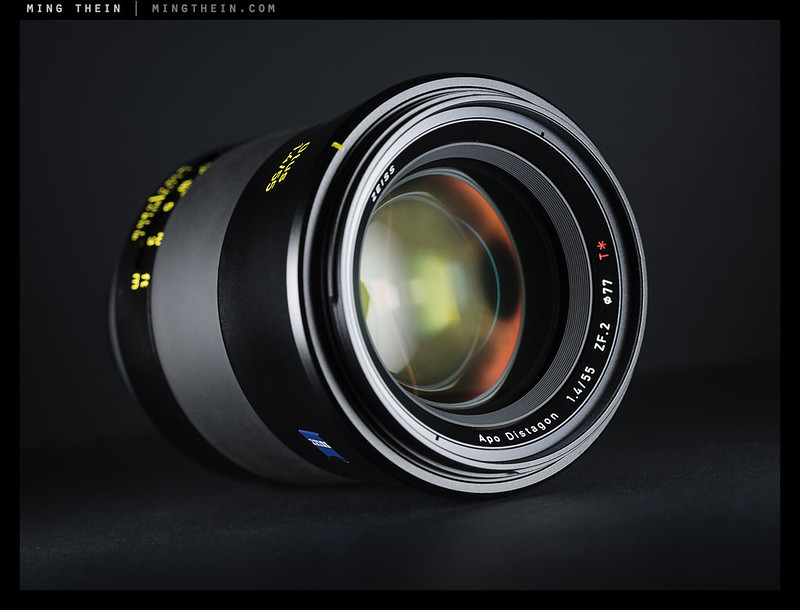
I’ve used a lot of 50mm and near-50mm lenses in my time*. I’ve had the privilege of owning or having on long term loan some of the legends – the Leica f0.95 Noctilux, for instance, the 50/2 APO-Summicron-ASPH; the Nikon 58/1.2 Noct-Nikkor; the Zeiss ZF.2 2/50 Makro-Planar. However, I can honestly say, hand on heart, that the Zeiss Otus 1.4/55 APO Distagon is quite possibly the best of them all.

_1M01078 copy
Insert gratuitous lens p*** here.

Note: there are others who have done a good job of far more comprehensive formal and technical tests, such as Lloyd Chambers, DXOMark etc. – this will not be that kind of review; I’m going to approach it from the point of view of what this lens was designed for: making pictures. I won’t be posting full size samples because I do not want to lose control of any images; and images that have no real merit shouldn’t be posted at all in any form. In any case, a large print is really required to see what this lens can do; no screen can do it justice. All images were shot with a Nikon D800E.

*Not even counting the equivalents on other formats: Nikon AFS 50/1.4 G; AFS 50/1.8 G; AF 50/1.4; AF 50/1.8 D; AI 55/2.8 Micro; AIS 58/1.2 Noct; AF 60/2.8 D Micro; AFS 60/2.8 Micro; AI 45/2.8 P; pre-AI 55/1.2 SC; Leica 50/2.5 Summarit-M; 50/2 Summicron-M; 50/1.4 Summilux-M ASPH; 50/2 APO-Summicron-M ASPH; 50/0.95 Noctilux-M ASPH; Sigma 50/1.4; Zeiss ZF.2 1.4/50 Planar; ZF.2 2/50 Makro-Planar; ZM 2/50 Planar; ZM 1.5/50 Sonnar; Otus ZF.2 1.4/55 APO-Distagon; CF 4/50 Distagon FLE. I’m sure there are others, but I honestly can’t remember them right now.

_1M01088 copy

_1M01048 copy
This is not a small lens. That’s an AFS 85/1.8 G in the background, and the image was shot with a 120mm equivalent – no perspective tricks!

_1M01044 copy
Balances reasonably well on a D800E body, but still definitely front heavy. Similar to a 24-70, actually.

You could probably stop reading at this point, but I think such a bold statement deserves some explanation, and the lens itself is worthy of much more serious consideration. Firstly, this is not a lens that will make sense or appeal to everybody; size, weight, manual focus and price will see to that. It is not any one property of the Otus that makes it outstanding over the others, at the expense of something else – an f0.95 maximum aperture, for instance, traded off against some serious lateral CA, moderate corner softness and a 1m minimum focusing distance; or a focusing helicoid that covers the last 2m to infinity in ten degrees – it is the fact that it not only holds its own but thoroughly embarrasses the competition at every single measurement; in fact, the lens’ measured MTF outperforms the theoretical maximum MTFs of most lenses. That’s quite some achievement.

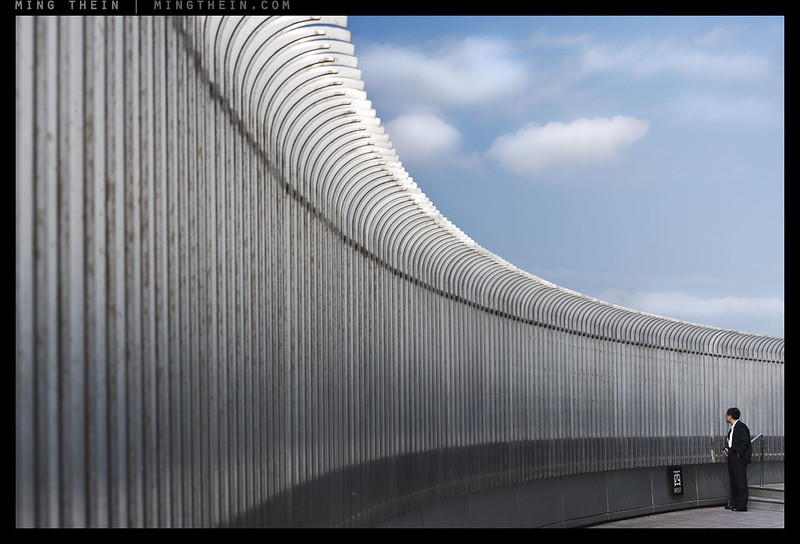
_8041831 copy
Only the clouds are truly free. Taipei. This image will be available in a limited edition print run to be announced in the next couple of days – stay tuned.

Of course, charts and numbers are not everything. There are lenses that test very poorly – Zeiss’ own 2/28 Distagon is one of those – due to aberrations such as severe field curvature; however, in practice, the way the lens renders is extremely three-dimensional and very, very pleasing. It therefore matters greatly how the lens renders in actual use; there are no numbers to describe quality of bokeh, for instance. Other qualities, such as microcontrast, are very easy to see but not so easy to measure. Some lenses have high resolution but harsh rendering – the Nikon AFS 50mms when stopped down, for instance – others are relatively low in fine structure/ microcontrast, such as the 58/1.2 Noct-Nikkor and late generation 50/1 Noctilux-M, but have very pleasing artistic qualities and ‘sufficient’ gross resolution.

_8043599 copy
100% crop here: note how the lens renders specular highlights in the water. Impressive.

It is very difficult to accurately describe the ‘Otus look’, but it’s definitely there, and quite distinct. I’ll do my best. I think it takes the best qualities of the modern Karbe-era Leica ASPH lenses (when their QC is on form), smoothes them out a little, and then adds the Zeiss three-dimensionality. Specifically, it splits an image very nicely into planes – at nearly any distance; there is a very fast transition between in- and out-of-focus areas. (I’ve always thought of that as a Leica ASPH signature.) The bokeh, however, is much smoother; it has the character of the ZF.2 1.4/85 Planar and ZF.2 2/100 Makro-Planar, but without the spherochromatism, longitudinal and lateral chromatic aberration. There are tiny trace hints of longitudinal CA, but you have to look very hard to find them and shoot bright sources to provoke it. Microcontrast at every aperture is stunningly good – very distinctly Zeiss – and this ability to differentiate between the most subtle of real tonal gradations means that subjects have a very three-dimensional quality, but with accurately rendered ‘bite’ and texture.

_8043817 copy
Chiang Kai Shek Memorial Hall and moon, Taipei

What this means is that even the most ham-fisted and photographically untalented reviewer on the internet can instantly see that they’re holding something very, very special. In the hands of a master, this lens is a lethal weapon: it is both utterly transparent and emphatically revealing. What the lens lacks in aberrations and flaws manifests as this clarity and transparency that’s very unique because so few other lenses can do this – the only few that instantly come to mind are the Olympus 75/1.8, Contax 2/45 Planar, Leica 35/1.4 Summilux-M ASPH FLE, Nikon PCE 85/2.8 Micro and Nikon 200/2 VR, but even the latter is somewhat overshadowed by its extreme bokeh. If there’s any coloration added by the Otus at all, it’s that it adds a tiny bit of pop and sparkle through the way it handles contrast and tonal transitions.

_8043293 copy
A tribute to the late Saul Leiter.

You’ll notice I haven’t said too much about the optical properties of the lens: that’s because there’s nothing much to say. Wide open at f1.4, the lens matches the resolution of the D800E’s sensor, even in the corners. Beyond that, you gain a little more microcontrast and of course depth of field; I think things plateau from around f4-f8, beyond which we start to see the effects of diffraction kicking in on the D800E’s sensor. The lens however delivers as close to theoretically perfect DOF as I’ve seen. I suspect that if we used a larger pixel-pitch camera such as a D4, we’d see consistent results to f16.

_8041668 copy
Highway overhead. 100% crop here.

The way this remarkable resolution is achieved is through a two-pronged strategy: firstly, making a truly apochromatic design means that all wavelengths of visible light focus on the same point. The lack of smearing means that very fine detail structures can be resolved, which in turn creates the impression of clarity. On top of that, the lens’ focal plane is nearly flat – no eccentric field curvature like the 2/28 Distagon, but a more realistic rendering, too. The optical formula is a 12/10 design with a rear telephoto group to ensure telecentricity of the outgoing ray bundle. The Distagon design is one that’s typically used for wide angle lenses to allow sufficient clearance for the mirror; ‘normal’ 50mm-e lenses use more symmetric double-Gauss (‘Planar’) style designs for simplicity. It’s also one of the reasons good wides cost so much more, and reasonably good fast 50/1.8 lenses can be had for very little money. I was told by the people at Zeiss that the Otus is in fact derived from a medium format lens design – the already excellent 4/50 CF FLE, which has a 9/8 formula – with additional corrective elements. Its image circle is in fact much larger than 35mm, hence the behemoth 77mm front thread.

_8044001 copy
Moon and clouds, shot handheld at f2. 100% crop here: this is a normal FOV lens that’s resolving craters on the moon.

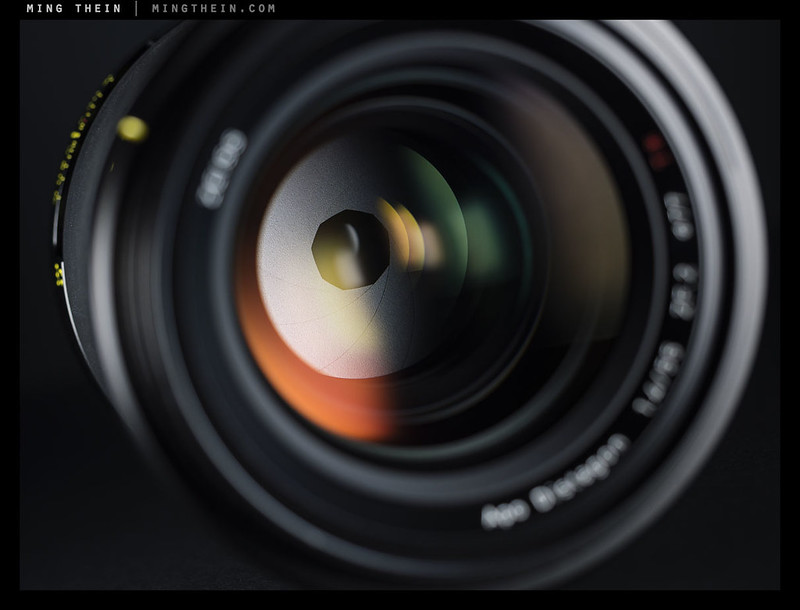
The Otus’ bokeh puts it amongst the best lenses I’ve seen, of any focal length, period. There is simply nothing offensive about it other than the occasional polygonal diffusion of sources if the lens is used stopped down (it has a 9-bladed diaphragm, but for some odd reason it isn’t perfectly round when stopped down), and with very bright lights. It’s generally a smooth wall with no bright edges, and a gradual transition between zones.

_8040941 copy
Bokeh.

Flare performance is pretty impressive, too: point light sources leave no ghosts, there’s no resultant veiling flare, and I can’t see any coma, either. Even with a source hitting the front element obliquely and slightly out of frame, there’s almost no visible lowering of contrast. I have to take the hood off and position the light source very deliberately before seeing even the smallest hints of flare. I’m told this is because of the way the sides and edges of the lens elements are coated: not only is the T* coating applied to the main incident surfaces, but over 100 different types of lacquer are applied to the edges of the glass to absorb any stray light.

To be continued shortly in part II.

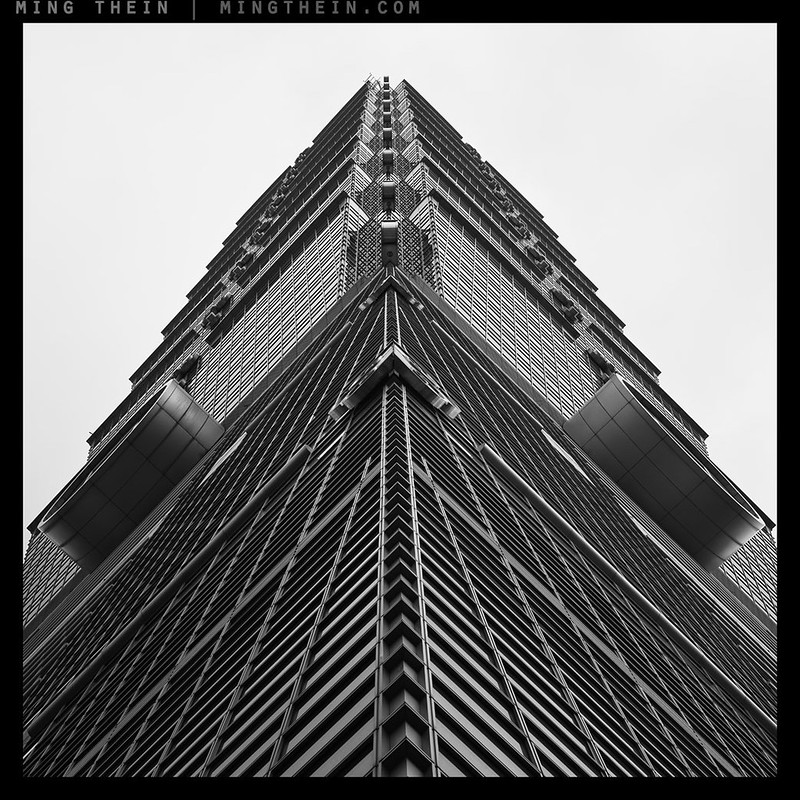
_8041774 copy
Taipei 101: Verticality IV

The Zeiss Otus 1.4/55 APO Distagon is available in Nikon and Canon mounts here from B&H.

____________

2014 Making Outstanding Images Workshops: Melbourne, Sydney and London – click here for more information and to book!

____________

Visit the Teaching Store to up your photographic game – including workshop and Photoshop Workflow videos and the customized Email School of Photography; or go mobile with the Photography Compendium for iPad. You can also get your gear from B&H and Amazon. Prices are the same as normal, however a small portion of your purchase value is referred back to me. Thanks!

Don’t forget to like us on Facebook and join the reader Flickr group!

appstorebadge

Images and content copyright Ming Thein | mingthein.com 2012 onwards. All rights reserved


Filed under: Gearhead: Reviews

Lens review: The Zeiss Otus 1.4/55 APO Distagon, part II

$
0
0

_1M01085 copy

Continued from Part One

Clearly, no expense was spared in the making of this lens. Unfortunately, this is also reflected in the price and size: a rather steep US$4,000, and a kerb weight (it actually sometimes feels like you’re aiming a tracked weapon) of around a kilo. It’s the size of a 24-70/2.8 from any of the big brands, and somewhat fatter, too. What you get for that money – aside from the outstanding optics – is a smooth, curved, all-metal housing and hood that mates flush with the front of the lens; rock-solid build, and quite possibly the best focusing ring I’ve ever used. This is of course very important for a manual focus lens, but it really is something else in terms of feel, feedback and haptics. Throw distance it’s perfect; it has enough resistance to stay put, but turns smoothly and has zero backlash – you can adjust focus with a fingertip. It also has a pleasingly tactile and grippy rubber ring, which is duplicated for the aperture setting ring. The mechanical aperture ring is of course only present on Nikon mount versions, which means that it’s also back-compatible with other mounts via adaptors – though you’d need a pretty darn good adaptor not to interfere with the planarity of the optics. Both Canon and Nikon mount versions have full electronic communication with the camera.

_8043549 copy
Truck geometry. Note lack of color bleeding, and resolving power that still stays at f16 – way past the D800E’s diffraction limits; there is some loss of microcontrast, but this is still an impressive performance. 100% crop here.

Just because I have waxed lyrical about everything thus far doesn’t mean the Otus is a perfect lens; there are a number of things I don’t like about it (aside from the size, weight and price). Number one is that it’s very, very difficult to nail focus accurately and consistently with today’s DSLR focusing screens; the lack of an appropriate focusing screen really holds this lens back – especially wide open; I’ve got a couple of replacement ones on order. A lack of resolution is almost certainly due to user error. On my F2 Titan and F6 (with Type A screen), focusing is significantly easier than the D800E, and it’s nearly impossible to do it precisely with the D600. The focusing dot is useless too – it stays lit for too much travel of the focusing ring. Zeiss should really think about making a decent focusing screen so people can make the most of their lenses; I bet they’d sell boatloads.

_8043394 copy
Things on a stick

There are a couple of performance issues, but I think only one (noticeable wide open vignetting) is the fault of the lens. The other is that I’m seeing some red/purple fringing overruns of a pixel or so on very high contrast areas – specifically in focus and very overexposed hard edged highlights. I’m told that the focal plane is so thin that what we’re seeing is a bit of residual second order CA; in practice, it disappears if we meter for the highlights, or stop down a little. To put things into context: my Noct-Nikkor (and 2/50 Macro-Planar) both do the same thing at f2, but with several pixels worth. It’s effectively not very noticeable in practice.

However, it is worth taking some time to consider an accurate definition of what the ‘APO’ designation actually means from a lens design standpoint. I quote Dr. Nasse at Zeiss:

The word ‘apochromatic’ has been originally used for the first time by Prof. Ernst Abbe related to his new type of microscope lenses which were much improved with respect to chromatic correction and appeared on the market during the 1880’s. He defined that lenses should match two conditions to be called Apo:

  1. Have three identical focus positions for three colors within the visible spectrum, or in more mathematical terms, the longitudinal chromatic aberration curve should have three zero crossings in the visible spectrum. From this follows, that then between these special points the focus deviation can only be small, resulting in a very soft secondary spectrum, so just small fringing occurs.
  2. In addition the spherical correction should be corrected for two colors within the visible spectrum instead of one in ordinary lenses. This means that condition 1) is not sufficient (especially in high speed lenses like the microscope lens with f/0.5 and more); not only the focus position is important but also the focus quality. In ordinary lenses also in the best focus e.g. of blue light the image is less sharp than for green or yellow light.

This definition is in the literature and in the minds of many people. However, condition 1) is nearly never fulfilled in photographic lenses. The basic reason is that they have much larger field angles than microscope lenses. In most photographic Apo-lenses the LCA curve is much more flat, but has just two coincident focus positions in the visible spectrum. Thus when one moves into the IR-range the focus deviation will increase so that a focus correction is necessary with a fast lens. Low chromatic aberrations with visible light do not mean that focus is constant also for extremely distant ‘color’. Zero dispersion exists with mirrors only.

_8044544 copy

The finish is my other bugbear: though it looks fantastic, like the regular ZF.2 lenses, it’s far too easily dinged and scratched, and impossible to keep clean. The front of the lens and front of the hood really needs a rubber bumper to stop it from getting nicked. I’ve taped up these high-risk edges with electrical tape so I can put the camera down without fear. The rubber focusing and aperture rings concern me in the long term: though they feel great, I have no idea how durable they’re going to be. Mine already shows some scuff marks from where it rubbed against other things in my bag – the camera strap’s hardware, for instance. I suspect you’re going to be able to tell how much a second hand Otus was used by the state of its rubber rings (if you find a second hand one at all, that is). The fluorescent yellow markings (all engraved and filled, including the hood) are a personal preference – I like them, but I know many who do not. Visibility under all light conditions is excellent. I’d really like to see weather sealing, though; especially around the little cutout where the distance and depth of field scales show: I’m really quite afraid that water is going to get in through what appears to be an open hole. It seems a shame that the lens is so ridiculously overbuilt on one hand, but a little vulnerable on another. And I’d like to use it under the same conditions which my camera would survive, of course.

_8043624 copy

The price and specifications of the Otus draw natural comparisons to its nearest rivals: the new Nikon AFS 58/1.4 G, and perhaps also the classic AI-S 58/1.2 Noct-Nikkor. The Leica 2/50 APO-Summicron-M ASPH is also mentioned, but it’s a stop slower, only available in a different mount, and nearly twice the price. I’ve shot extensively with the latter two lenses, and tested several samples of the 58/1.4; the Otus is still the best of the bunch. It doesn’t have the flare problem of the APO-Summicron, and focuses closer. I’m sure somebody will have tested both the APO-Summicron and Otus on a Sony A7r body and come to the wrong conclusion due to irregular adaptors; they’re designed for very different uses, which I feel makes it an unfair comparison.

_8043604 copy

The 58/1.4 G is not very sharp wide open – it suffers from some coma and flare – and never really gets perfect in the corners; I think the AFS 50/1.8 is actually slightly sharper. Both lenses lack the microcontrast and bite of the Otus; they also suffer from both lateral and longitudinal CA until stopped down. The Noct-Nikkor is spectacular past f2.8, excellent at f2, and merely good in the center at f1.2 (and a disaster in the corners). It was a remarkable achievement for the day, and still has a very pleasing painterly rendering quality, but it is no match for the Otus, even at its optimum aperture it never quite delivers the same level of microcontrast. I believe the new 58/1.4 G was designed to deliver similar pictorial qualities to the Noct-Nikkor; and in that it succeeds. Both 58s would make excellent portrait lenses, but I’d be very, very careful whom I turn the Otus on. I don’t have enough experience to say for certain, but the look and rendering style of the Otus is as close as you’re going to get to the look of the Zeiss Master Primes used in cinema – right down to the lack of any visible focus breathing. This is not a coincidence: the same team who designed those Master Primes also designed the Otus.

_8041818 copy

This has turned into the longest lens review I’ve ever written; so long I had to break it up into two parts to make it readable. It wasn’t by design; there’s simply been a lot to say. The Otus is a benchmark lens in many ways: it is really the first lens designed from scratch to make the most of the D800E’s sensor at any aperture and thus extend the creative envelope; the next lens in the line will be a 1.4/85, with a wide and possibly macro to follow soon after. I am personally hoping for a 21mm tilt shift or 1.4/28, but that’s almost certainly not going to happen. At any rate, the current ZF.2 2.8/21 Distagon is an excellent performer on the D800E, if not quite up to the standards of the Otus. It is a lens that is currently without peer for many reasons, and in many ways. I can only hope that a substantial portion of the price goes towards quality control; other brands are capable of outstanding designs, but sample variation kills resolution in practice. However, the consistency of responses amongst those who have tested and seriously put the Otus through its paces makes me think that this is not the case with Zeiss, and my personal experience with 20+ lenses in different mounts and of different vintages further supports this.

_8043059 copy
Did you know this building has a fine tile facade? Neither did I, until I examined the file at 100% – see here. Yes, it has such high resolving power that it will induce moire. This is about as bad as it gets, actually; I haven’t done anything to correct it.

I think it’s pretty obvious that I really, really love this lens; not just because its resolving power enables me to step up a level in my fine art printmaking, but because of the transparency in the way it renders. It really is quite possibly the best lens I have ever used, for any format. Comparing the three days of intensive shooting in Taipei to excursions with previous equipment, I’ve never quite produced as many images that I’ve felt really captured what I saw; I don’t know if it’s the lens closing that gap or something else, but I feel that level of clarity over other lenses is definitely noticeable on-screen, and really jumps out at you in a large print.

_8041755 copy

If you have the means and opportunity to own one, do it. Learning the shot discipline to extract its full potential can come later. Yes, it’s not a cheap lens, but then again, when you compare it to its nearest competition performance-wise – the Leica 50/2 APO ($7,350) and to a lesser extent, the Leica 50/1.4 ASPH ($4,000) – it’s actually not that bad. No other brand has anything that comes close, especially on the 36MP+ cameras; that said, you really do need to have outstanding shot discipline, good eyesight and a D800E or better to appreciate the full difference. But if you do, I think you’ll find it’s so outstandingly good that you too will feel a small pang of disappointment when you have to use anything else. I am fairly confident that it will be remembered as being a modern legend. Who’d have thought I’d fall in love with a normal-angle lens? MT

The Zeiss Otus 1.4/55 APO Distagon is available in Nikon and Canon mounts here from B&H.

____________

2014 Making Outstanding Images Workshops: Melbourne, Sydney and London – click here for more information and to book!

____________

Visit the Teaching Store to up your photographic game – including workshop and Photoshop Workflow videos and the customized Email School of Photography; or go mobile with the Photography Compendium for iPad. You can also get your gear from B&H and Amazon. Prices are the same as normal, however a small portion of your purchase value is referred back to me. Thanks!

Don’t forget to like us on Facebook and join the reader Flickr group!

appstorebadge

Images and content copyright Ming Thein | mingthein.com 2012 onwards. All rights reserved


Filed under: Gearhead: Reviews

Lens review: The Zeiss ZF.2 1.4/85 Otus APO-Planar

$
0
0

_8052572 copy

One year after the 1.4/55 Otus APO-Distagon, Zeiss is back as promised with the second installment in the new line of super-lenses: the 1.4/85 Otus APO-Planar. Announced unofficially on facebook several months back, the lens makes its official debut at Photokina. I’ve had the opportunity to shoot with a final-pre-production prototype for the last two months; in fact, through pure coincidence, I got the email from my contact at Zeiss saying they had a surprise for me on my birthday…

_8052576 copy
Gratuitous lens p***.

A huge thank you to the team at Zeiss for the opportunity. I should note in the interests of editorial independence that this review has not been restricted or censored in any way, and there were no usage limitations placed on the lens: in fact, if anything, I was encouraged to push it to the limits. And I did. Test images were made on a Nikon D800E and D810. I’ll be uploading more images to this set on flickr as time goes on. If you recognise some of the sample images in this review from the Zeiss website or stand at Photokina, that’s probably because I shot them…

_8052590 copy
This is NOT a lens for the weak-armed.

I’m going to call it the 85 Otus from here on, because the full name is a mouthful, and we need to differentiate it from the earlier 1.4/85 Planar that was made in ZF (non-electronic), ZF.2 (electronic), ZE (Canon) and ZK (Pentax) mounts. It’s a derivative of a venerable old design that dates back to the Contax/Yashica days. On the D700 and D3, that lens was one of my favorites because of its extremely cinematic rendering style and flare resistance; it just begged to be shot against the light at every possible opportunity. On the relatively forgiving 12MP sensors, the 1.4/85 Planar was critically sharp in the center even wide open, and not too bad at the edges. Unfortunately, come D800E – we were in for a bit of a rude shock. I actually tried half a dozen samples of this lens before coming to the conclusion that it was simply not usable wide open on the 36MP cameras – softness, lateral CA, longitudinal CA, coma, mild astigmatism – you name it, it didn’t go away til f4. And that very much defeats the point of a fast f1.4 lens. The shooting envelope became very small indeed – and we haven’t even talked about focusing it accurately, yet.

Ming_Thein__8B02481 copy
Queenstown at midnight.

Ming_Thein__8B02481 crop
Enough resolution for you? This a 100% crop of the above image – remember, its a distant subject with some mild fog, minimal sharpening, and an f2.0 long exposure. Pixel level quality of this combination is not just superb by 35mm/ FF standards, it’s superb by ANY standards – the best of medium format included. It’s quite possibly the best I’ve ever seen, consistently.

I was sad, until the Otus line was announced. And then mildly horrified at the size of the 55 – if that was the normal lens, how big would the short fast ‘portrait’ telephoto be? Turns out the answer is quite enormous. The lens weighs in at well over a kilo, takes 86mm filters, and has a hood that’s about 110mm in diameter. It’s a good 20cm long with hood in place, and honestly, the closest thing in size (but not weight) is the Nikon 200/2 VR without it’s companion hood. This lens is a monster.

Ming_Thein__8B01494 copy
Rush hour, Kowloon.

Design and construction are much the same as the Otus 55 (and to a lesser extent, the Touit family) – this is clearly the new design direction for Zeiss. It’s smooth, solid, and for an odd comparison, seriously intimidating in an ergonomic way, much the same as an injection-molded composite firearm such as the FN P90. Everything that appears to be metal is metal. Focusing and aperture rings are made of grippy rubber; my 55 Otus has become not so grippy after six months of heavy use; Zeiss is looking into the issue. There is no plastic on this lens, other than the lens cap.

Ming_Thein__8B02918 copy
View from Coronet Peak, Queenstown, New Zealand

Unfortunately, the lens cap design is poor: the springs are too lose, and the plastic is too thin for its size. The two sprung tabs have a habit of coming loose on my lens, and sticking open – upon which the cap just doesn’t stay on. It could use a few more teeth, too. Given the amount of attention paid to every other part of the design, this is a little disappointing (more so, since it’s not exactly easy to find a replacement 86mm cap!). I’ve got one other gripe with the Otus design –it’s that the hole for the focusing scale can collect moisture, which if you’re shooting under adverse weather and very cold conditions can freeze and cause the focusing ring to bind. The water came out again, and I didn’t see any evidence of moisture inside the lens. In all fairness, Zeiss does not claim either Otus to be weather proof – a shame, in my opinion since the strongest images are usually to be made under the most foul conditions. Interestingly, after using the 85 Otus, the 55 feels positively svelte…

Ming_Thein__8B03109 copy
Mount Alta before the storm, from lake Wanaka, New Zealand

Peer down the end and you wonder why some of the lens is empty; like the 55 Otus, the coatings on the elements are so good that there’s very little to no reflection, which renders the first few elements pretty much invisible so long as the front is clean. To an aficionado of optics, this is an incredibly sexy lens. Pretty impressive, considering the lens is a 11/9 design – that’s a lot of elements, but to be expected because of the extreme degree of optical correction. This of course means several things: firstly, you can shoot it into the sun without fear of flare (the edges of the elements are coated in the same way as the 55 Otus, too) or loss of contrast*; the T stop is extremely close to the numerical f stop, and color transmission across the entire spectrum is superb. As with the 55 Otus, I’d say the color siguature is moderately saturated but mostly accurate with a very slight cool bias.

*I actually don’t use the hood on this lens because it’s just too fat to pack easily into most of my bags. It’s a good thing it doesn’t need it other than for impact protection, as far as I can tell. I suspect the concave front element has something to do with the lens’ flare resistance, too.

Ming_Thein__8B03452 copy
Shotover Gorge, Queenstown, New Zealand

Next up is the easy part: I have tried, but really cannot find any major issue with the optics. There were some instances of what appeared to be magenta/purple edges on very high contrast and overexposed detail, but I don’t know if this is a sensor or lens issue. It isn’t present with proper exposure. Other than that – there’s no visible chromatic aberration, longitudinal or lateral. Contrast is amazing at every aperture, as is microcontrast and ability to resolve high frequency and low contrast detail structures. Resolving power does not appear to improve with with stopping down; it might do, but even at f1.4 it appears to outresolve the D810.

Ming_Thein__8B03632 copy
Can anybody identify this galaxy? I searched online for some time and drew a blank. 6 seconds at f1.4 – there’s no CA or coma to be seen anywhere in the frame, even the extreme corners.

I see a slight improvement in microcontrast to peak arounf f2-2.8, but even at f1.4 it’s delivering far more than my Nikon 70-200/4 VR or 85/1.8G does at any aperture. There is some vignetting wide open that disappears by f2.8 or thereabouts, but it’s easily fixable. I did not see any major distortion. All in all: this is seriously impressive performance, and just as good or very slightly better than the 55 Otus. The lens also appears to be fairly flat-field: you must compensate by back focusing slightly if you center focus and recompose for an edge subject.

Ming_Thein__8B03623 copy
Between water and rock

On the subject of focusing, I think this is going to be the biggest hurdle for most users: even with my custom focusing screens, calibrated mirror and finder magnifier, it’s extremely challenging to consistently hit critical focus wide open. The viewfinder system is simply inadequate. The only optical finder-based method I’ve found that can nail focus involves racking it slowly while shooting a burst – disastrous for critical timing, but just fine for static subjects. Live view and a tripod is of course highly advisable.

Ming_Thein__8B03954 copy
Just before sunset, Arrowtown, New Zealand

Ming_Thein__8B03954 crop
100% crop of above.

Most of the time, I used it either on a tripod with live view or stopped down; this is partially because I just don’t shoot wide open that much, and partially because when I do, it’s because I want to use the lens’ ability to separate out distant subjects from the background without any penalty in resolving power. I find this very slight isolation helps immensely with creating a perception of depth in the image. It’s also worth noting that as for the 55 Otus, you won’t have to recompose after focusing: the 85 Otus does not appear to suffer from any visible focus breathing, which will also be of interest to cinematographers.

Ming_Thein__8B03630 copy
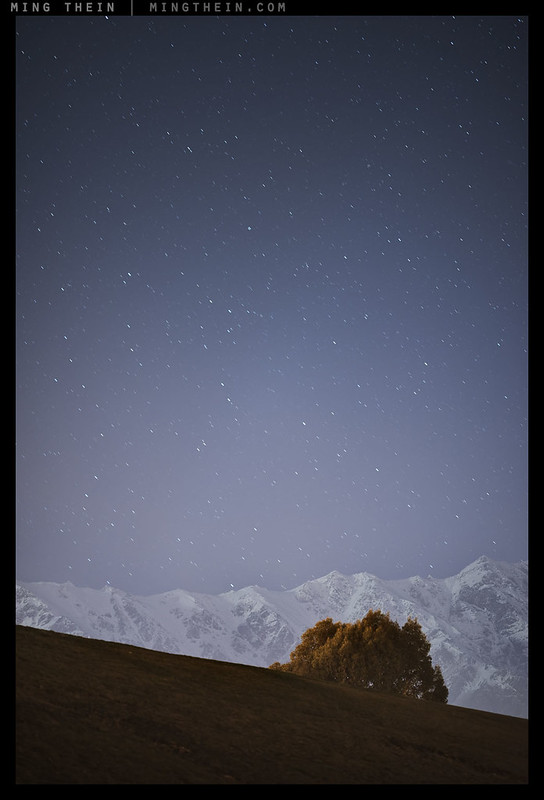
Tree and mountain – shot wide open at f1.4, the stars are slightly blurred because the plane of focus is the tree. Fortunately a very still night; still enough that the tree blow in the wind at all, and individual leaves are clearly defined.

If the old 1.4/85 was a cinematic lens, the new one is, too: out of focus areas are rendered very smoothly and non-distractingly by the 9-bladed diaphragm, even with high-frequency complex subjects at distances relatively near to the subject. There’s a trace of spherochromatism and bright highlight edges under some very specific situations, but for the most part, it’s invisible. More tellingly, out of focus foreground areas are rendered in a delicate, veiling way: they’re clearly there, and contribute to the feel of the scene, but they never distract. There’s only one small fly in the ointment: for out of focus very distant point sources only, you see concentric ring texture in the big round highlights – this is an artefact of the polishing/grinding process of hybrid aspherical elements (moulded + bonded asphericals). It is only visible under those circumstances, and also present on the Otus 55 – though we seldom notice this because most out of focus sources we photograph aren’t sufficiently point-like. I was told that you either need to have spherical elements that do  not require this polishing process, or an extremely costly polishing process (as used on the Master Primes) to eliminate it entirely. Bottom line: not noticeable in 99.999% of normal use situations, but remember, we’re looking for perfection here…

Ming_Thein__8B03666 copy
Even horses feel cold sometimes

Ming_Thein__8B03666 crop
100% crop of above. Shot wide open at f1.4, very minimal sharpening applied. As usual, if you see haloes…it’s flickr’s downsizing engine.

I’m not necessarily sure the new lens is more atmospheric than the old one, though; I always felt the old lens had a bit of character of its own, but the new one is a very transparent lens – much the same as the 55 Otus. Use them interchangeably at any aperture for a consistent look. Its signature is that it imposes no visual signature of its own (visual signature is usually a result of ‘endearing’ optical aberrations, such as swirly bokeh). This is not a lens whose look you can rely on to add personality to an image: it transmits what is there, nothing more, nothing less. Color transmission and accuracy of rendition is utterly brilliant – slightly better even than the 55 Otus. I was utterly blown away when examining the files from New Zealand on my calibrated monitor. Lloyd Chambers and I are in agreement that this is possibly the most highly corrected lens ever for a DSLR; his detailed evaluation of the 85 is here. There is something in the way the 85 Otus renders that goes beyond even the 55; it is the very definition of ‘clarity’. Subtle nuances are perfectly rendered and you get the feeling of being there. In my mind, this puts it in the very highest class of lenses – the kind that cede full creative control to the photographer, and serve solely to execute their vision. It is an optical achievement of the highest order.

Ming_Thein__8B03521 copy
Tree and river

Through this review, you’ll note there are no direct comparisons. I simply don’t see the point. The 85 Otus does things in the corners that no other Nikon lens can do at any aperture; there is no comparison. Even with the Pentax 645Z’s 90/2.8 SR – one of the best medium format lenses I’ve used – there is no comparison. Curiously, the math due to the increased sensor size and extra pixels on the Pentax works out such that the 645Z/90SR and D810/85 Otus combination deliver almost the same pixel dimensions for a subject at a given fixed distance. This means we can almost compare the lens-sensor combination like to like. There’s no question the Pentax/Sony sensor is superior to the Nikon even at the pixel level, especially in dynamic range; however, the 85 Otus leaves the 90 SR trailing. It must be stopped down to f4-5.6 to match the Otus’ resolving power at f1.4 in the centre, and f11 in the corners; and microcontrast/transmission never quite catches up. It’s possible sample variation has something to do with it – I’ve only tested one 90SR, though – they’re rather rare birds here. Still, I think that’s extremely impressive.

_8A17062 copy
Evening.

However, note that it’s not a lens for everybody: dedication to technique and vision are required to extract the most from it. Then there’s the cost and size/weight issue: I’m sure many keystrokes will be wasted to explaining why alternative X at $1000 is better. If you have to even ask why, this is not the lens for you. It may well be comparable if you get a good sample and stop down a bit, or don’t print and only view online; but a big part of the reason why the Otuses (Otii?) are so expensive is because of Zeiss’ QC procedures. I have used half a dozen Otus 55s and two Otus 85s for various reasons and from various batches/ owners – they are all, as far as I can tell, identical in delivering the same extremely high performance. This is not a trivial achievement: any of you who can shoot to the level of maximising everything out of your equipment and have tested more than one sample of a lens will know that consistency is almost impossible to achieve. I have never personally seen any other brand with this level of consistency. If you cannot see the difference (and no web image is going to do it justice; full resolution on a high grade monitor as a minimum, a print ideally), then don’t bother – buy a cheaper AF alternative and not have to deal with manual focus. Extremely shallow depth of field wide open plus that beautifully crisp transition between in and out of focus areas makes achieving critical focus both necessary (missed focus is obvious) and challenging; beyond that, if you don’t have a camera that can make full use of the resolving power and color rendition of the lens, or the skill to deploy all of that potential, it’s somewhat wasted. I honestly feel that the lens still has more to give – but we don’t have the sensors for it yet. I suppose that’s future-proofing. My accountant is already making unhappy noises, but personally, I can’t wait for the next Otus…MT

Coda: I’ve solved the focusing issue with a Zacuto pro finder and live view – stability, magnification, real DOF – just makes the whole thing a bit bulkier, unfortunately.

The Zeiss 1.4/85 Otus APO-Planar is available here to pre order from B&H in Nikon and Canon mounts.

__________________

Limited edition Ultraprints of these images and others are available from mingthein.gallery

__________________

Masterclass Venice (November 2014) now open for booking – click here to book or for more info

____________

Visit the Teaching Store to up your photographic game – including workshop and Photoshop Workflow videos and the customized Email School of Photography; or go mobile with the Photography Compendium for iPad. You can also get your gear from B&H and Amazon. Prices are the same as normal, however a small portion of your purchase value is referred back to me. Thanks!

Don’t forget to like us on Facebook and join the reader Flickr group!

appstorebadge

Images and content copyright Ming Thein | mingthein.com 2012 onwards. All rights reserved


Filed under: Gearhead: Reviews

Photoessay: Dusk to dawn in Queenstown

$
0
0

_8B04013 copy
Sunset cloud shadow

On my recent trip to New Zealand, I spent some time exploring an aspect of photography which I hadn’t really done much work in up til now: long exposures, night work and astrophotography. Unfortunately there was only one clear night for the latter, and the duration of exposures + noise reduction meant not a whole lot of individual shot opportunities; still, I’m fairly pleased with the outcome – definitely something I’ll have to revisit in future.

_8B03312 copy
Moonrise

This set is organised as a sequence from dusk to dawn; they weren’t shot on the same day, but around the same 20-odd square kilometre area around Queenstown. I find the most challenging part of very long exposures to be a problem of visualisation: what’s going to become visible or overexposed or over-contrasty is not easy to estimate beforehand, and the meter is of course useless once light conditions become too low. The best way of working I found was to do a test exposure at maximum aperture and a much higher ISO – 3200 or 6400, above that, tonal response starts to become nonlinear when compared to lower ISOs – then scale up your exposure time accordingly. Above a couple of minutes, long exposure noise reduction becomes necessary; for one of these shots (the tree with star trails) the total capture time was close to an hour. The experience of sitting by a very still lake with the Milky Way stretched overhead is one I’ll never forget – I’ve seen it before, of course, but not with this level of clarity with the naked eye. All I can say is that it really puts you in your relative place in the universe.

This set was shot with a Nikon D810 and Pentax 645Z. A couple of technical notes: these were captured before my D810 went in for the white dot fix; I had to junk a lot of long exposures because of the stars that didn’t move! On the whole though, I’m very impressed with the long exposure noise performance of both the D810 and 645Z. MT

_8B03630 copy
Tree, mountain and stars

_64Z2041 copy
Lake I

_8B02481 copy
Lake II

_64Z2533 copy
Milky Way

_8B03632 copy
Unidentified galaxy (if anybody knows which, I’d appreciate a hint!)

_64Z2544 copy
Trees I

_64Z2541 copy
Trees II

_64Z2047 copy
Approaching dawn

_64Z2055 copy
First light

__________________

Take your photography to the next level: 2015 Masterclasses now open for booking in Prague (9-14 Mar 2015) and Lucerne (17-22 Mar 2015)

__________________

Limited edition Ultraprints of these images and others are available from mingthein.gallery

__________________

Visit the Teaching Store to up your photographic game – including workshop and Photoshop Workflow videos and the customized Email School of Photography; or go mobile with the Photography Compendium for iPad. You can also get your gear from B&H and Amazon. Prices are the same as normal, however a small portion of your purchase value is referred back to me. Thanks!

Don’t forget to like us on Facebook and join the reader Flickr group!

appstorebadge

Images and content copyright Ming Thein | mingthein.com 2012 onwards. All rights reserved


Filed under: On Photography

Announcing the Cinematic Masterclass in collaboration with Zeiss: Hanoi, Jul 21-26 and Jul 28-Aug 2, 2015

$
0
0

_7016973 copy The fifth Masterclass will also be the first specialised one, on a topic I’m frequently asked to teach: the cinematic style of photography. It will take place in Hanoi, Vietnam, from 21-26 of July 2015 inclusive. Better still, Zeiss has agreed to loan us with a suitcase of lenses*. As usual, the Masterclass is limited to just 8 participants, so please confirm early to avoid disappointment; read on to make a booking and for further information. For all of you who’ve been asking me for a Masterclass in Asia, here’s your opportunity :)

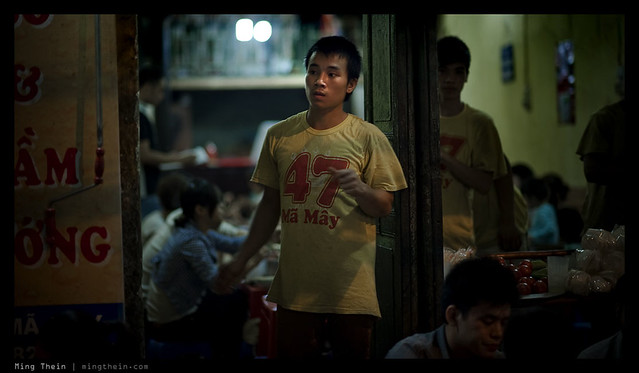
18/4 Updates: Taking standbys for the first session, second session (28/7-2/8) now open for booking. *More importantly, Zeiss have updated me on lenses – the really good news is we will get the 1.4/55 and 1.4/85 Otuses in Nikon and Canon mounts, along with the 2/135 APO and 2/28 Hollywood Distagon… :) _7017695bw copy The Cinematic Photography Masterclass, in collaboration with Zeiss Hanoi, Vietnam Dates: 21-26 July 2015 inclusive (session 1) and 28 July – 2 August 2015 inclusive (session 2). Note: this is not focused on video, though similar fundamental principles apply. This article covers an explanation of cinematic photography in more detail. 

Duration: 6 days, four practical and two classroom

Tuition cost: US$2,200 for workshop only, $2,500 special bundle including Outstanding Images Ep. 1-5 and Intro to PS Workflow (required, but most participants usually have some or all of these already – the bundle can be altered accordingly.) There is also a special price for previous workshop attendees – please send me an email if you’re interested.

Want to be challenged? Inspired? Push yourself to take your images to the next level? Want to make emotional images that look as though they could be stills from a movie? The Masterclasses are aimed squarely at you. The Cinematic Masterclass is for the photographer who already understands the basics and is looking to experiment with making distinctive and emotional images that carry a unique style, evolving creatively and spending some time with like-minded individuals. It is not limited just to street or controlled scenes; cinematic is a wide style that can be applied across a very broad range of subjects. The aim is no longer about building core fundamentals by exercises, but to work on vision, the ability to assess and curate one’s work, application of style, postprocessing, and being able to put together a coherent set of images to an objective. _7017983 copy Prior to the course, participants watch the video set (Outstanding Images Ep. 1-5, Intro to PS workflow, with a special focus on Ep. 4 and 5) to bring them all to a common level; they then prepare a portfolio of 10 cinematic images to be reviewed on the first day. Even within that general remit, there are a wide variety of possibilities – everything from film noir to natural to the modern trend for anamorphic lens flare and extreme lighting and color. All images in this post were shot in Hanoi; for more examples of the cinematic style, please see this set on Flickr. _7016864bw copy The first day is spent in the classroom as a group reviewing each photographer’s portfolios, and setting specific things for them to focus on. This is very important because creative pursuits have no right or wrong and it can be useful to have as many points of view as possible. Throughout the next four days, I’ll spend half a day with each participant individually and meet everybody at least once (and usually twice) a day for a round of feedback and discussion on the day’s captures. The feedback loop is intense, focused and helps fill in the gaps in one’s toolkit. The final day is then spent back in the classroom with a new portfolio of 10 images: again, we assess and this time, post-process to complete the workflow between vision, capture and output. _7017511 copy In summary, the program is as follows:

  • Day 1: Introduction to cinematic photography and critical style elements; technical considerations including focus, previsualization and setup; portfolio review and individual goal setting along with ‘The Assignment’
  • Days 2, 3, 4, 5: Individual participant intensive sessions and daily review. Most photography will be done earlier in the day or late afternoon/evening.
  • Day 6: Closing portfolio review, postprocessing and workflow for cinematic with a particular focus on control and consistency of color grading

Participants will need to have a large sensor mirrorless or DSLR camera, fast prime lenses (even a 50/1.4  on a DX body is perfectly adequate) and a laptop to post process on. Nikon or Canon mounts are best since Zeiss has also generously agreed to loan us some suitable lenses for the Masterclass in those mounts, too. Manual focus fast primes are also excellent (even older glass via adaptors such as the Nikon AI 105/1.8) especially if paired with an EVF, waist level LCD or LCD magnifier*. A tripod is also useful so you can set up shots and work with a little motion blur, such as in the Venetian Cinematics. *The Zacuto Z-Finder Pro or Kinotehnik LCDVF are both good options. For travel planning purposes, it’s preferable to arrive a day earlier and leave the day after (or extend a bit to see the greater area) as we will have our usual opening/ closing dinners. It also makes sense to stay at the same hotel for easy meeting logistics and frequent feedback; this has worked very well in the past for participants at previous workshops. I am planning to stay at most probably the Movenpick or the Sofitel Metropole, which are both ideally located for easy access to many historical districts in Hanoi and will update participants in due course. _7017223 copy This will be the fifth masterclass following HavanaSan FranciscoVenice and Prague. Each masterclass has been fully subscribed and every time it gets even better; clicking on those links will take you to the previous reports, participant thoughts and more importantly, the work produced during the sessions. I’m continuing to refine the masterclass format to even further improve the balance between focusing on the individual development needs of the participants, whilst allowing space for creative experimentation. What I like about this structure is that it allows for students to be inspired by each other – photography is after all highly subjective – as well as operate at the level that works best for them. And you can do it multiple times because the syllabus is tailored to your individual needs. There is also an excellent and detailed report from one of my Havana participants, Michael Letchford, here. To book a place for one of the Masterclasses, or for more information, please send me an email. This session is limited to just 8 participants. I am looking forward to shooting with you!

Selected testimonials from previous Masterclass participants follow.

Emil Varadi (Prague March 2015 Masterclass):  I’ve stumbled upon Ming’s website a few years ago coming from the DPReview lens forum. I was at that time interested in the Zeiss ZF 21∕2.8 lens and someone pointed at his review of this lens. His site was new to me, so being a gearhead myself , I also read his Camerapedia pages and skimmed through his whole site then concentrating mainly on his gear reviews. It did not take long to notice that he had plenty of perfectly composed images, pictures of real artistic merit, which was actually a welcome surprise. A lot of guys talk about gear and photography on the web, but their artistic output is well, even mildly spoken: dubious. I have been and I am still am subscriber to manuals∕gear review pages and have spent many many hours on the web beachcombing for worthwhile content on photography. Months and months passed, Ming started his Master Classes and I’ve seen from him a steady flow of perfectly composed photographs, which had a slightly unnatural, darkish, but very pleasing coloration. I immersed more and more into his writings and his photography already then 
started have an impact on my shooting. In the meantime I saw Ming’s free Havana tuition video and also bought his three discounted  tuition videos. When he announced his Prague Master Class, I knew the time 
has come. True, I got some nudging from my wife, who is also an eager photographer. Prague had a special significance for us: our photographic fever started exactly there 12 years earlier.
Prague started and ended in a „classroom”, by Ming analyzing and commenting first the 10 best images we bought with us, and at the end, the 10 best images we made during the course. In the meantime, every morning and noon we had the opportunity to seek his opinion on the images we made that day or the previous afternoon.  Also all of us had a half day with him personally, when we would go out shooting side by side.
It is also important to mention, that on the very first day, Ming also asked everyone, what was our aim with the course. I happened to mention that my photography usually has a human focus, humans are part of my compositions. This at the time seemed to me just a casual sentence I said then to explain what I was generally shooting, but by the end of the course I had to realize that this sentence does have a much deeper philosophical meaning. I have come back to this thought ever since.
Let me try to explain. Ming is photographing compositions: buildings, objects, street scenes, where – occasionally – humans are also included but mostly as requisites for a perfection seeking composition. I think that Ming is the best out here with his compositional skills and capabilities, I’ve seen practically numberless compositions from numberless authors, but he is tops in this genre, if not the best, then
certainly one of the very best. (And more importantly from your aspect, he is able to pass on to you much of this. It’s only up to you how much you utilize). So yes, composition is the alpha and omega of photography. So if you can develop   good∕better∕perfect composition into your everyday language in photography, then you can get very very far. By the end of the course I have seen quite a few excellent images from other participants that I would happily hang on my wall or call my own. (Primarily Patrick’s
image of a statue of a man hanging outside a window.)
Regarding photography I have come from a different school. Having been a journalist for 35 years I knew many great photo journalists and have seen even more great news photographs. This genre is primarily about human drama, the word drama used in a very broad context here. (By drama I do not only mean strong human emotions, but a smile, a grin, a facial expression, a human gesture that communicates outside the image). To humans humans are the most important subjects. We would look with interest at
another human being rather than on a composition of objects. We resonate better to other humans. Having been practically immersed into such photographs more than half my life, no wonder they had great influence on me and no wonder I tend to put humans in the focus of my photography. Humans that are not just esthetic compositional elements in a picture but humans that do somehow communicate outside the plain of the image.
I have mentioned some of this to Ming, definitely not with such clarity as I myself have not put these things into their proper place at the time. Then I felt that human „drama” portrayed on an image easily overwrites compositional principles and it is the „drama” that talks to us, that really hooks us to the image. (Ming said something like we cannot expect much drama on the streets of Prague anyway and human drama – well composed – will have greater photographical value. In this he is definitely right. (Still, that very day the two of us have stumbled upon a drug addict, a woman, sitting in the staircase of the parking lot to Prague’s Wilson Railway Station. She was sitting silently on the filthy stairs stinking of urine, and held an injection needle that Ming later said she would use to inject heroin into her arm. The woman looked at me as we bypassed her on the way up. I still cannot forget her hopeless dark brown eyes. So there’s human drama for you even on the streets of Prague, something we did not photograph for ethical reasons.)
So what did Prague bring for me? The most important part is something seemingly very simple: the understanding that one needs to compose carefully. Very carefully. An amateur beginner would say sure, what’s the big deal? One needs to be at a high level to grasp the real difficulty of this simple sentence. Because in Ming’s terms this means practically pixel level perfection. Coming home from Prague I skimmed through several years of my images only to realize how sloppy I was before, how many good
chances have I missed, by not taking better care. I just did not know before. The other lesson was how to balance a composition, what to watch for in an image.
I think I have gone home from Prague with a highly useful set of tools, but I will need much more practice to become fluent in their use. I know I will never achieve Ming’s levels of perfection, as neither I have the patience nor his abilities, but for my purposes I will be very satisfied.  Also it is important that we know, what we do and what we do not want. No, I will not be chasing the ideal of perfect compositions of objects, but I will definitely use the skills learned for the human aspects of my photography. 

Ian Carroll (Prague March 2015 Masterclass): Prague was fantastic, and I will be back again. Great MC, with a great bunch of guys, and some stunning images on display in everyone’s final 10. It has taken me 2 whole days to curate down to about 400 images, which considering half the time the weather was very familiar feeling (grey, flat, boring, damp and unpleasant) is something. Most of the guys only had 1 good shooting day, weather-wise, and despite this produced great images…I think if the weather had held out we would have had all 3.5>4+ s. And I know, there is no such thing as “bad light” but still, it is alot easier to find inspiration and worthy subjects when the sun is shining! Thanks again for your time and mentorship, and for going the extra mile in trying to make it a more personal experience….I know this doesn’t come easy for you, nor for me, but I think it adds a lot to the mentor/mentee relationship.  it was very rewarding shooting (or at least seeing) alongside you as a fellow photographer rather than as just a paying student.  Although I am not overly enthused by my own output, I know why I am not (different gear, weather, being too distracted with Gerner and Junaid…in a good way!), and I came away with a feeling of validation, which was important to me.

Michael Letchford (Prague March 2015 Masterclass): All good things must come to an end as they say, so it is with much regret that Ming’s Prague Masterclass came to a close yesterday with a very positive final review day. It was my last chance this morning to steal an hour in the rain, trying out new kit with the sole challenge of subject isolation. Not so easy when it’s pouring down! Never mind, got some good shots of wet pavements and people under brollies taking their Sunday morning strolls in empty streets. Very evocativeThe Masterclass was once again very challenging, but great work and much progress came out of it. Final Day Review was very inspiring ……. Thanks go to Ming for his unending patience and encouragement and skillfull criticisms – always focussed on pushing you forward. It was a great group, comprised of many talented people. You couldn’t help but be inspired. Must try harder!

Junaid Rahim (Prague March 2015 Masterclass): Curating and processing finally completed and time to share my thoughts on the Prague Masterclass! This was my second Ming workshop, the first being in Amsterdam some 18 odd months ago. That set the foundations and ‘principles’ for what makes an image and the Masterclass took this to another level. I actually came into the workshop in a bit of a ‘photographic rut’ and needing some inspiration and motivation to pick up the camera and shoot. The workshop started with us all sharing out 10 images and it was a sobering experience getting the feedback on what worked and what didn’t. Armed with this feedback we began shooting with some incredible light on the first day. The workshop challenged us to be more critical and more importantly the participants challenged each other to be better. We each also had a session with Ming to work on a certain aspect. Needing some help with experimenting my session involved us working with a tripod in the evening experimenting with the ‘Dancing House’. We spent 3 hours freezing to the bone on a bridge (with Ming you don’t get very far as he points out various things that could work…) experimenting with different angles and that was invaluable for what I wanted to achieve. Though the weather sadly didn’t hold up for the rest of the week, we were getting stronger images as we started to ‘see’ more effectively. At the final review session, the progress in the final 10 images the participants showed was outstanding – as a group we even worried Ming slightly before he started his curation  ;). But in the end Ming showed his experience and presented an incredible selection – we didn’t expect anything less from our teacher :) . On top of that the group we had was fantastic and we had some good nights together. Thanks again Ming, it was great fun and onto the next workshop when and wherever that may be! And if anyone wants a look, my photographs from the workshop: https://www.flickr.com/…/125049303@…/sets/72157649274730284/

Kevin Foisy (Prague March 2015 Masterclass): The Prague Masterclass was my first workshop with Ming and won’t be my last.  Ming has a direct and very intentional style of instruction that is straight to the point. His workshop is demanding and free of fluff that one might find in other venues. On our first day, during image review, Ming identified areas that we could work on to achieve our workshop objectives; mine was compositional balance and aspect ratios. Shooting with Ming in beautiful Prague helped me to see what I was missing and in the end achieve better, more balanced compositions.  My fellow photographers were both an inspiration to me and a joy to socialize with. I’ve learned, improved and made new friends; exactly what I had hoped for!  A great week with Ming in Prague and highly recommended.

Gerner Christensen (Prague March 2015 Masterclass): Having participated in the Masterclass (MC) workshop in Venice end of November last year, I had my doubts should I be able to adapt and benefit from new endeavours already so soon after? I was still under impression and working on the outcome of the first MC while the chance occurred to participate in a new Masterclass in Prague. Feeling a bit odd to attend so soon again, I felt even more odd letting such a chance pass. After all it was astonishing beautiful and charming Prague that should host us and the city has been high on my priority list for quite some time. It was also a unique chance to work with Ming again and there were participants I so utterly wanted to see and to be together with. Now soon 3 weeks since the the Masterclass took place, I must say I do not regret at all. As we all did, I too bought my 10 images for a review and I must say it is quite rewarding having such qualified feedback from such outstanding photographers as I truly admit the whole group were. But just as rewarding it is to have a chance to give one’s opinion back to 70 outstanding images. It is on such rare occasions one’s fantasy starts boiling, our attention and senses are fully alerted, and we are getting new ideas and broadened and perspectives to one’s own work. I brought of course my objectives for the workshop, but they were already altered during the first days review session. There you go, the teaching starts immediately after the first imaged has been shown. OK, I brought my ideas about transcending the stocked way I have been shooting up to the MC by trying to add a twist to my work to make it more interesting to look at. Crossing the borders of my comfort zone and what have we, I learned my objectives changed a bit already during the course. I was encouraged by Ming to curate before I even took the shot and that makes a lot of sense in my case because how often haven’t I wasted data and time just to fire on some object and then hope for the best. I can’t say I fully succeeded, but I certainly went a big step in the right direction. By giving a possible shot a second thought you will also start distilling the idea about what it is you want to say with the shot. *Is it me to shoot this?* *Is the right light for the scene?* *Does it bring anything new to the table or is it just another cliche to the many already taken?* … These are questions I will ask myself in the future while running and gunning out there! Hah .. and then all my troubles bringing an inadequate tripod for my new D810 and its heavy glass was certainly a lesson I brought home too. Saying to myself and others *Oh .. I am not a tripod guy anyhow, so never mind* , well that isn’t actually the case to be honest, and Ming really was helpful to advise me what to buy while he saw me struggling and suffering with my dry spaghetti Gitzo I had brought. While I rushed to the local gear shop who advertised they had more adult stuff on stock, I was disappointed to learn that they had not! Well since not all our workshop days had strong light etc. I also faced many of my shots were shaken or robbed DR because of early auto ISO kick in. Nevertheless I got enough quality shots in order to curate for our last classroom day. I had my 10 images and I liked them. Even more did I like many of the 10’s my dear fellow participants brought! It was an amazing day with so many master shots I would have wished to have taken myself, and the good question could be *Why didn’t I*? The critique and feedback from Ming and the group were priceless and there were such a common energy present while we all took and gave, all while being taught and induced new ideas upon our efforts … it is hard to say otherwise than the harvest actually felt bigger than the seeds you sowed yourself. So also this time I am overwhelmed by the progressive process it is to pass a Masterclass. It is so rewarding and I would do it again and again so long there are Masterclasses to attend. I want to thank each one in the group for all we had together and in particular thank you Ming for being such an inspiration and source of photographic wisdom. It was unforgettable and enormously enriching. Thank you all!

Patrick Hautle (Prague March 2015 Masterclass) – Even though I read all the enthusiastic comments that previous masterclass participants left on your website, I came to Prague unbiased and open to any outcome. In retrospect I can say that they were not at all exaggerating. I experienced a very dense week which has left some strong marks in my approach to photography.
The early discussion we had on distraction and the minimum number of elements needed for a story helped me very much to review my previous practice of framing. Your straight, clear cut and always well thought critique brought me on the track to compose much denser images. Looking back it’s amazing to see how much progress is possible in a few days with proper and instructive guidance.

Gerner C (Masterclass Venice): Dear friends, back from the WS in Venice. In short it was by far the summit of my photographic experience ever. Beside enjoying endlessly the beautiful and romantic city of Venice, the whole WS, the come together in the spirit of learning and sharing, was an almost spiritual experience for me. Almost, wrong word?.. why do I doubt .. better to say it certainly was a spiritual experince in the sence of trancending oneself and becoming filled with joy and solid trust in my ability to become a better photographer. The weather was like it was. Not too much sunshine and strong shadows actually, some rain too. But I certainly learned that any weather and any light during the day and night 24 is good weather and light. What held me back shooting only in sunlight? Belive me the light during first meeting day and end of the last was of indiscribable quality. The sea around Venice breaks the light into such wonderful colors that I hardly knew existed. It was overwhelming and a pity we were’nt blessed with that quality light during the week. just shooting the light would be able to stand alone. The food was of course excellent… and pretty expensive = Sea Food! Anytime I have a chance to eat fresh seafood, I’ll take it. Probably because I am basically built up from seafood molecules the 48 years I lived in Denmark ;-) I miss it here on the continental Balkans. The group was certainly a fantastic group as I am convinced all Mings WS groups are. The devotion to photography was very very intense and strong from the biginning and much stronger at the end. I think all participants would agree on that. All of us went through a dramatical conversion from start to end. An impressive personal transformation and output showed at the end of the WS for all of us. From tense anxiety in the beginning to fun and vivid fluency at the end. Being together around photography in Mings atmosphere and the following growing awareness of being a member of a team left us all in an immence state of dedication and love for photography. Ming has to be hold a great deal reasponsible for making that happen :) I came to Venice with the wish of basically improving balance in my images. Simultaniously make them more interesting to look at. Ming told me to concentrate on visual balance around the subject and keep out non essential stuff. Yeah man .. precicely what I needed being able to do! The shootout with Ming was an unforgettable experince. How can I express it? It was like having borrowed Ming’s eyes for light and composition for some hours and being left with a permanent footprint, some seeds in the photographic soil in ones head. It is about furtilizing those seeds now and let them grow. We did not ahve much of any shadows, so we decided to do painterly photography. For sure Ming was painting super realistic with his camera and he simply sees what is the obvious where I do not even sense there is an inherent immage to bring back home. Amazing! Thanks Ming showing me how you work and interprete Mother Earth and the human creations. Thank you for being such a share willing soul. Thank you being the way you are, an outstanding person of which there are far too few of on this planet. I was told to slow down and dwell more with what I see and for God’s sake taking my tripod with me forcing me to do so. It showed to be a very good suggestion and haven’t I been that lost in the process of making The Image of my life, I would probably not have left the tripod on that garbage bin I put it on doing the only handheld shot I made Wednesday afternoon. Back to early auto ISO kick in to leave out my handshake !!! Weuww.. noise and loss of tonal quality was a concequence. I have to admit I did have problems making the 750 working 100% for me during the week and Ming had to grab my camera to improve settings for me the way I want to use it. Oh… yeah, Ming also adjusted the AF fine tuning of my 3 lenses … in silly 20 seconds !!!! However, things peaked of course at the last day showing each other our curated 10’s. I have never ever seen that concentration of excellent photography in so short time. Period. The group had grown the level of quality at least a star and a half up compared to what I saw at the first day. Incredible but true. I can’t remember if there were any of the 70 image deliveries that was voted under 3 stars out of four. Or were there? I can’t remember.. there were so many four star images. Believe me, for the first time I really understood what the four things means. Need I to say following Ming curating his images and do his 10 live on stage is a previledge beyond the four dimensions!!! Needless to say that I (we) am/are certainly not the only one/s carrying the gear interest decease! Holy Moly…! I am not left alone with that syndrom I can asure you… :) Now all these impressions and learnings of course have to sink in and hopefully it translates into my photography being less imballanced and boring. I think it will. I really do hope I would have another chance to participate in a Masterclass WS in the future. Excuse me if I bored you guys with this longer post. I couldn’t make it shorter and had my English been better it would have been much longer ;-)

Holger F. (Masterclass Venice) : Home again and having done my backups to save our precious work I gratefully want to join the praises you all made in the foregoing mails. This fantastic mixture of hard work ;-) within a wonderful group of inspiring and hearty people will be kept in my mind forever. Thanks to all of you adding this outstanding days to my experiences of life.
A special thank to Ming for his never ending patience and discipline leading this workshop to a great success for all of us. Ming, I greatly admire your educational skills which enables you to transfer – at least a part of – your knowledge to us.

Rudolf F. (Masterclass Venice): Everything said already I could subscribe to as well. I enjoyed the learning experience and the inspiration gained from Ming and all participants. One sad note: It is getting more and more difficult to come home with a picture that is to my satisfaction, the expectations have been raised to a new level. But after all, that’s what we paid for – and it’s good so.
With best wishes to all of you and always good light. Watch the edges! 

Michael S. (Masterclass Venice): I only can double what Phil said. I enjoyed every minute and it was great to meet you all. For me it was relaxing and demanding – i learned a lot and hopefully will be able to reproduce that in the future. Thanks again to Ming for his professional and always friendly manner! This and our evenings made it an outstanding week for me.

Phil L. (Masterclass Venice): Thank you all for a highly rewarding week bringing excellent insight and enjoyable company. I feel refreshed as a photographer with new ideas and new ways of seeing. And of course a special thank you to Ming for his expert guidance, workshop preparation and approachable, friendly manner. Spending 6 days purely on photography has been a wonderful indulgence that I will benefit from every time I lift a camera to my eye. Thank you Ming.

Joe Atkinson (San Francisco Masterclass) – Your breadth of experience and skill, combined with your personality, teaching style, and flexibility created an unforgettable week of photographic immersion. I was unprepared (“Know your equipment!”), but it didn’t matter. You created a flexible structure for each of us to define and then pursue our goals; I learned not only from you, but from each of the other participants. I especially appreciated how you taught to both our strengths and weaknesses, and how you let us (literally, in my case) drive our own agenda for our session with you. I can still hear the echo of your advice every time I look through the viewfinder: “Take your time!” Thanks for the many words of straight-forward advice and thank you for a great experience at the SF Masterclass! 

Andre Yew (San Francisco Masterclass) – 5 Great Reasons To Attend A Ming Thein Masterclass
1. The pre-workshop portfolio selection. Picking ten images to show who you are as a photographer makes you think really hard about the kind of photographer you want to be, and that in turn will help you make a plan for what you want to learn and how you can improve. When do we really
get to think introspectively about what we’re doing? It’s also really tough!
2. Individual, extensive coaching from Ming. Ming wants to help you be the best photographer you can be, whatever your photographic vision or goal may be. He isn’t interested in making clones of himself. You may already have a distinctive photographic style, but that artistic vision could be held back by technical issues. He’s going to be blunt about telling you what you need to fix, but he’s also going to help you fix those problems. In my case, working on a couple of compositional issues is going to make my work and what I want to say stronger, clearer, and more consistent than ever before.
3. Your fellow students. The positive atmosphere, enthusiasm, and great energy of your fellow students are infectious! Each day, I looked forward to seeing what everyone else had done, and it was really great to see how everyone had improved and changed over the course of only 5
days at the ending portfolio review.
4. Seeing how Ming works. Lots of people have written about seeing Ming edit, and that is truly a wonder. But when you’re out in the field with the man, and see him bound down a hill with a large tripod in one hand, and a large roll-aboard camera case in the other chasing a fading sunset, or standing in the cold fog freezing various body parts off just to get one more shot, you can’t help but be inspired by his energy and enthusiasm. He truly loves photography, and that rubs off very easily.
5. Having a whole week just to shoot with no other concerns. When else will you have permission to have a whole week just for yourself, working on your photography? In my normal life, I get to shoot only on the weekends, but this concentrated week has helped me improve considerably.

Gary Getz (San Francisco Masterclass) – The Masterclass was a fantastic learning experience for me! My goal for the week was to inject mood and feeling into my images, which I viewed as an aesthetic aspiration; but what I quickly learned was that I needed to put several technical building blocks in place first. After two days of practice on technique, I received the all-clear (and some great guidance) to work on my initial goal — and the improvement in my results was clear. The half-day that I spent with Ming one-on-one, working on a very specific set of skills, was absolute gold — Ming watched me try things my way, and then rapidly diagnosed my opportunities for improvement and taught me some fantastic principles and tricks of the trade that I know will serve me well for years to come. And the interactions with my fellow students were fantastic, both during the formal portfolio reviews and the daily lunchtime get-togethers where we compared notes and received input from Ming. I’d certainly sign up again, with an eye toward other parts of the photographic universe — who knows, maybe next time it will be architecture or landscape!

Margaret Cheng (San Francisco Masterclass) – Aside from yearbook photography in high school, I consider myself a casual photographer who started photography back up about 5 years ago when my husband (David) and I went on safari in Kenya and Tanzania at which time David introduced me to digital photography and Lightroom. Since then, we have usually reserved our photographic efforts for vacations, resulting in mostly landscape photography.
Previously, we participated in a couple of workshops led by pro photographers. I was interested in learning more about composition (other than the rule of thirds!), what made a photograph good or bad, and how it could be improved in-camera and with post processing.
Those workshops were great for showing us where and when to go to a particular location at the right time of day for good light, but unfortunately, they always seemed short on meaningful instruction. I always went away feeling disappointed that I didn’t learn as much as I would have liked, especially considering the potential of how much the instructor could have taught us. I think that it’s just easier to comment on technical things like exposure, etc. rather than perform critiques or teach someone how to develop an eye for what will be a good photograph.
Judging from his website, we felt that if anyone would be a good teacher, it would be Ming. We felt that the Outstanding Images course would be the most appropriate level for us, however, Ming assured us that we would be up to speed after watching the videos, and we signed up for the Masterclass.
Being in San Francisco, we assumed that the class would be mostly urban photography, which we had never really done. So our pre-work came in the form of watching the videos, and going in to the city to practice taking photos of buildings and people. I found that having to develop objectives for the class and then culling down to 10 images for the pre-class critique really crystallized the learning process, and made the critiques more valuable.
The critique of the student images on the first and last days of the masterclass was incredibly interesting and eye opening. Not only for the breadth of images, but also for discovering what others liked and didn’t like about images and also more importantly, Ming’s opinions on why an image works or doesn’t work, and why.
Critiques on compositional elements in the context of your own (and other student) images that are more subtle than the “rule of thirds” were incredibly instructive. Ming’s teaching style helped to guide us on how to make a strong image once the photographer decides what the primary subject is.
It turns out that San Francisco has so much available, that we really could have concentrated on landscape (micro-landscape), night photography, urban architecture, and/or street photography.
David and I teamed up to do one session of street and one session of landscape photography with Ming, and it was incredibly instructive to see how he works, and what he sees as potential subjects. And also what potential subjects just wouldn’t work for a technically good photograph and why.
We also had the opportunity to get together with Ming everyday at noon to get feedback on some curated images, and then he would give us general themes to work on, such as subject isolation, trying more vertical images, etc. The daily feedback was incredibly valuable, in that we knew what we wanted to do, but it was valuable to get feedback on whether we were successful meeting the objectives. This provided significant value added over his blog essays about composition, etc.
When Ming talks about the 4 things, the first item is light. For him, if the light isn’t good for the subject, he doesn’t even bother with the shot. From spending the week with Ming, I am now much more critical of the available light, and if I am taking photos in poor light, I know that it is just for practice. I now also have subject isolation engraved into my brain, with a much better idea of what I want to do to create a better composition. This understanding of what makes a good image has also helped me to delete photos.
I encourage anyone who has a chance to enroll in a class with Ming to go ahead and do so. It will be a great experience, and Ming really likes to teach!

David Pope (San Francisco Masterclass) – With a background in wildlife and landscape photography, I was a little intimidated at the prospect of attending a “master class” in San Francisco that would presumably force me out of my comfort zone in order to learn how to do street and people photography. Furthermore, having watched (and been highly impressed) by Ming’s Outstanding Images video series, I was wondering how much further the instructional material could be developed, given the nature of the workshop format and having 8 students with highly divergent goals…
On the first count, it turns out that in as diverse a location as San Francisco, one can (and we did) do all kinds of photography — street, architectural, landscape (including water, trees, and SF fog!), in addition to abstract and night photography. And Ming, fabulous teacher that he is, made it easy to learn how to do things I had never done in my photography before.
And on the second count (and quite obvious in hindsight), the Outstanding Images videos are just a foundational piece so one can benefit from the personalized syllabus of a Masterclass.
Beyond that, the workshop transforms Professorial Ming (on video) to Caffeinated Ming (in person), ablaze with so much enthusiasm for the craft of photography that you can’t help but be caught up in his energy. To be sure, this is a high intensity 6-day workshop, and you need to be willing to put in 10+ hour days in order to reap maximum benefit from Ming’s approach to photography.
Entering the workshop, my photographic goals were fuzzy — to “improve the rhythm and balance in my photos” — but we quickly zeroed in on improving my toolkit, so I worked on subject isolation, filling the entire frame so as to use the perspective of the lens properly (no cropping, groans Ming!), and using portrait orientation to create layers of depth within my photos.
Among the unanticipated benefits of the workshop: camaraderie with fellow students — seeing the images they created each day and learning from their honest critiques; the daily lunchtime review sessions with Ming to get instant feedback on scenes you just finished working; watching post-processing live, and realizing how little is necessary when an image is conceived of (and executed) properly; and shooting with Ming in the field — how he sizes up a scene that is either worth shooting (or not), what perspective and vantage point is chosen, how quickly he works, and the ruthlessness with which he discards an image that isn’t a 10 out of 10 in his mind’s eye. (The group even developed a new DxOMark standard — “mingsharp” — to denote an image reflecting enough Shot Discipline to be considered Ultraprint-worthy.)
Highly satisfied with the whole experience and looking forward to participating in another workshop in the future!

Scott Loftesness (San Francisco Masterclass) – Spending a week with Ming in my hometown of San Francisco was a unique learning experience. His focus on shooting precise, great images is intense – almost overbearing at times. But that’s what provides the stretch – the pull to do better, to get up to the next level. He’s a tough coach – pointing out flaws and compromises while urging a stronger commitment to shooting at a higher level. By the end of the week, I was exhausted – from the physical experience on the streets but also that feeling of good exhaustion that follows exploring the limits and pushing for better. My initial goal was to refine my personal style. Turns out Ming said I already had one. Instead he urged me to move beyond – to leave “stages” behind and to see more in three dimensions. This proved to be a big challenge – where I made some small progress but feel him looking over my shoulder urging me to see differently, to reduce my tendency to zoom, and, above all, to stop cropping in post!

Doug Kaye (San Francisco Masterclass) – I’ve been inspired by Ming Thein’s street photography for some time. I’ve learned quite a bit from his blog and videos, but I wanted to get a more personalized perspective on how I might integrate aspects of his approach to street photography with my own style. I got exactly what I wanted from the San Francisco Master Class.
Ming doesn’t hold back. He has strong opinions and let’s you know what you’re doing that works for him and what doesn’t. His criticism is always constructive, albeit within the scope of his own style. (Hey, that’s why you’re there, right?)
Having studied with a few other masters, I’ve learned important lessons from each of them. If you appreciate Ming’s images, if they inspire you as they do me, I highly recommend spending a week in this class.

Alex Ohta (Making Outstanding Images Chicago) – It’s been a couple days since we wrapped up the Making Outstanding Images workshop, and I’ve been reflecting on my experiences. I’ve wanted to attend one of these workshops for a while. Scheduling didn’t work for 2013, so I resigned myself to wait until a 2014 US workshop opened up. In the interim I read everything. And then I started downloading videos. I recommend watching and even practicing the concepts (including post processing) prior to attending the workshop, doing so makes the in person experience hugely rewarding.
The syllabus is well thought out. Despite starting with the basics, things ramp up very quickly. Each lesson layers over the previous, and by the end of day one all the core concepts were covered. Day two was a stretch for me – not only were we trying to abide by the lessons from day one, but we were also trying to apply stylistic choices. I personally found the group critique and post processing sessions on the final day to be invaluable.
The most liberating part of the whole experience is that I no longer feel frustrated with my output. I find myself just wanting to shoot – subject doesn’t matter, the more diverse and challenging the better. I’ve also got a road map for growth for the next six to twelve months.
Thanks Ming & fellow classmates for a great couple days. I’m eagerly awaiting a 2015 masterclass schedule.

Dan Tamarkin (Making Outstanding Images Chicago) – An exceptional workshop in the qualities that make an image outstanding and the process of creating them. Personalized and immediate, this workshop is invaluable instruction, and Ming Thien’s direct instruction and constructive feedback are as useful as the atmosphere is positive and nurturing. Highly recommended – a joy to participate in.

Steve Child (Making Outstanding Images Chicago) – Ming’s teaching style is methodical and easy to understand. After the first day I began to see in an entirely new way and it was reflected in my photographs. An amazing experience!

David Kimmel (Making Outstanding Images Chicago) – The recent ‘Making Outstanding Images’ class in Chicago was a truly amazing experience made so entirely by Ming’s outstanding skills as an instructor. The course quickly identifies the elements lacking from your images but it also raises your awareness of the things that you are doing on pure intuititon. Only when we are fully conscious of the elements that make strong images, can our photography improve. This is accomplished primarily through Ming’s ability to quantify the many elements found in strong images and describe them in an approachable way that only a truly experienced photographer with the gift of exposition could. The course is extremely challenging forcing you to face your shortcomings while enhancing your strengths. Ming shares openly from his vast experience in virtually all areas of photography without a sense that anything is held back. His energy seems boundless and his enthusiam is infectious inspiring you to shake off the despair you might feel from seeing dozens of duds on your memory cards and forge ahead to create the images you have always wanted to make. The course does indeed teach you How To See, a skill that will last a lifetime of shooting.

__________________

The Hanoi Cinematic Masterclass (21-26 July inclusive) is now open for registration – click here to book and for more information.

__________________

Visit the Teaching Store to up your photographic game – including workshop and Photoshop Workflow videos and the customized Email School of Photography; or go mobile with the Photography Compendium for iPad. You can also get your gear from B&H and Amazon. Prices are the same as normal, however a small portion of your purchase value is referred back to me. Thanks!

Don’t forget to like us on Facebook and join the reader Flickr group!

appstorebadge

Images and content copyright Ming Thein | mingthein.com 2012 onwards. All rights reserved


Filed under: Teaching

A visit to Zeiss and thoughts on the Milvus line

$
0
0

_Q116_L1030551 copy
The mothership

I was fortunate enough to spend the last three days at Zeiss with Lloyd Chambers (update: his blog entry is here) – with a level of access that I suspect that has never been granted before to independent external parties. They were gracious and first class hosts – I don’t think I’ve had that many types of non-alcohlic beer before. We asked every question we could think of and more, and received answers which we had never expected and at a level of depth that has left me deeply, deeply impressed with what the lens team is doing out in Oberkochen. This may seem like a strange way to talk about the new announcement, but bear with me for while; there is method to the madness. :)

_Q116_L1030556 copy
Origins: it all began with a microscope.

The atmosphere at Zeiss is a very collegial one: there are doors, but nothing seems to prevent both discussion and excitement spreading between all levels of the team. Everybody is passionate and genuinely excited about their product: many are also keen photographers themselves. Whilst we were there, we had access to everybody right up to Dr. Winfried Scherle, head of the camera lens division. Information and ideas are openly shared, and the products are not developed in silos. However, the business of camera lenses is a very small one overall for Zeiss – semiconductors and medical dominate (Dr. Scherle was joking that they are after the decimal point in Zeiss EUR4.2bn annual turnover). It means that there is both pressure to produce products that can match the other divisions in ROI, but also that there is less restriction on developing unusual product that carries a high business risk and potentially small audience (Touits, Otuses).

Zeiss’ Cine lens division is also rightly famous – the lenses have a very high reputation in the industry, and for good reason. They carry a unique rendering that is consistent throughout all of the lenses in each given series (Master Anamorphic, Master Prime, Ultra Prime, Super Speed, CP.2) and in practical terms it means the director and DOP do not have to worry about each scene in a production carrying a different look – this is especially important where there are a lot of fast cuts. Having used the Master Primes myself last year during the Nissan commercial, I can see why. They are assembled at the Oberkochen HQ in an environment that reminds me less of a factory and more of a watchmaking atelier. Lenses are assembled by hand, adjusted by hand, and QC’d rigorously – but with the latest technology. We were lucky enough to tour the inside of the facility, but had to suit up in full clean room procedure before doing so – this is to control dust. First time rejection rate is high and each lens frequently has to go through multiple adjustments (element recentering etc.) before passing through final QC; MTF and a number of other parameters for each lens are measured live on a specially built K8 machine during assembly. Needless to say, tolerances are extremely tight – as one would expect from lenses that can top $30,000+ each.

_Q116_L1030564 copy
Planetarium at the museum – they sell far more of them than you’d expect.

The obvious question now becomes one of relativity: what does this have to do with the price of fish? It is arguable that the Master Prime line is Zeiss’ halo photographic product. Two things filter down through the rest of the lens families: the obsession with quality control, and recently, the visual consistency within a family. It is not just the Cine lenses that pass through adjustment on the K8: Dr. Hubert Nasse, Senior Scientist (and man of infinite knowledge of optics, responsible for the Otus line amongst other things) says there are over a hundred K8s at Zeiss and partners – all used to inspect and adjust lenses on the production line. The difference between say a Master Prime and a Batis or Touit is one of QC: the Master Primes take a day each to assemble and check/adjust; every single Otus is also tested and adjusted with the K8 machine; the rest of the lenses on a reducing frequency. It of course costs time and money to test and hand-adjust every single lens. We were told it is possible to design something with amazingly good optical performance these days with the power of modern computers – but putting it into glass and making several thousand of them at a price which the average photographer can afford is something else entirely. Design compromises have to be made for ease of production; there is no point in having a very ‘sensitive’ optical design that can be perfect but drops to mediocre if one element carries the slightest misalignment.

In real terms, the measured MTF10/20 represent a lens’ ability to reproduce high contrast gross structure of an image; the MTF40 (40 lp/mm) is for fine details – except that was the standard set by the resolving power of film, not today’s digital sensors. The D810, A7RII, 5DSR etc. need 130lp/mm+ lenses. This bring the natural question: why do we not see measured MTF80 or MTF120 values, especially for manufacturers touting higher performance? Dr. Nasse answered this question very simply: such values are so unstable to measure and so critical of machine alignment (each measurement machine has a huge number of moving components that must be micron-perfect to give a meaningful result) and focus that they are not meaningful. The same lens would be almost certain to deliver different results on different machines – but is likely to do so also on the same machine if remounted and refocused. Somewhat worrying when we are effectively attempting this in the field all the time when photographing…and a very good illustration of why resolution gains can fall off very quickly in practice.

_Q116_L1030558 copy
Lloyd Chambers contemplating history

Despite so much being stacked against us, it is still possible to achieve excellent results in practice a high proportion of the time – otherwise I certainly wouldn’t bother with the cost and weight. More importantly, the glass must continue to be able to deliver as time goes on – both from normal wear and tear and as sensors of increasing resolution place higher demand on the optics. I think this is reflected clearly in the longevity and reliability of Zeiss’ lenses: at the risk of being called a fanboy, I admit to having owned more than 30 from the late 50s all the way through today. None of them have gone back for service (except one Otus which had some forensics done on the rubber ring, and a bit of dust removed) – and there have been zero mechanical failures, and only one questionable or inconsistent sample out of all of those. On top of that, many of the older designs still perform well on modern sensors (though not all) and multiple samples are remarkably consistent – this was demonstrated with a series of production Otuses on Dr. Nasse’s own K8 machine – not only was performance consistent between lenses, but consistent across the entire field within the same lens. Lenses are even tested with multiple wavelengths of light (unlike the single wavelengths of a lot of other testing machines) all the way out to the extreme corners. We saw remarkably little skew and almost no astigmatism. That is an astonishingly good performance on all fronts, and the kind of thing that really builds confidence*.

*We also saw the results of lenses from competitors, including some we brought ourselves. The results…clearly demonstrated why an Otus is an Otus.

If you have this degree of a) consistency and b) longevity even within the consumer lens lines – which has been designed in from scratch with the Otus, and the Batis family, to a lesser extent the Classic line, and intentionally with the new Milvus designs – it means that if you can find something that works for you visually, you will be inclined to keep that set of lenses for a long time. Moreover, you will want to use those lenses for a long time. I have found that personally in the Otus line – I just wish they had more focal lengths – and doubt that will change, short of Zeiss making a set of lenses to my specifications**.

**I will have to win multiple lotteries first.

Much has been said about manual focus, and I agree with the current state of DSLR viewfinders, it’s not very practical in the field. Live view helps, but requires a tripod or bulky LCD magnifier. Combine that with two Otuses and something for the wide end, and you need a chiropractor and a Sherpa. Sony has solved this problem for us to some extent with the A7RII. Live view magnification and the stabiliser extend the working envelope of the Otuses – and any MF lenses – enormously; even if the ergonomics are compromised. And it is much easier to place precise focus that way than with AF – there is still a finite size to the smallest AF box, and it can make the difference between hitting eyelashes or pupil. The reality (and I pointed this out in my review) is the shooting envelope of that combination is MUCH larger than anything a DSLR can currently deliver. Note that yes, I am using Nikon lenses on a Sony body. But what if Sony develops its usual product ADD and decides to discontinue the Alpha mount? I would not want to be stuck with E-mount Otus lenses for a dead system; being 100% mechanical and manual ironically adds a degree of future proofing. I know I can use my Otuses on pretty much anything to come – with the same excellent optics, and a consistent look.

_7R2_DSC1252 copy
The first of the Milvus line

I think you can see by this point that the argument for a lens system as opposed to a camera system is starting to make a lot of sense: you have one set of lenses that works on everything, and simply pick the best body for the job. On a tripod, or in a studio setting, I’ll pick the D810 body. In the field, handheld, I’ll pick the Sony. But both will mount Otuses and deliver a consistent look (after profiling the camera, of course). This is massively powerful: but something filmmakers have been enjoying for decades. It is something new to the photographic world, however. Though we also enjoy variety of rendering amongst lenses, I really would prefer to have a consistent rendering that works with my creative vision – if that vision changes, I’ll get new lenses.

_Q116_L1030582 copy
Multiple copies of every lens and different system bodies from Nikon, Canon and Sony were on hand for the media to test

The Milvus is the start of that change at the consumer level: the lenses are also designed to be consistent in color and overall rendering, which is why we have new 1.4/50 and 1.4/85 lenses; the old ones did have a unique rendering but were not consistent even within the rest of the ‘classic’ line (which continues to remain available). Other lenses that do not match will also be redesigned – there is a reason why we now have only six lenses for launch, but far more in the classic line. There have also been significant mechanical changes: aside from a new external design (beware pinching between the end of the barrel and hood, though) and more secure hoods, the lenses now all have full weather sealing, more visible scales, better overall gripability and a selectable clicked or steeples aperture (for video) – there is a small toggle in the rear mount, similar to the Loxia line.

_7R2_DSC0167 copy
Milvus 50 on A7RII

I have been shooting and testing the new 50 and 85 for some time now, and find that the gap to the reference – of course the Otus – has been closed quite significantly. The 50mm is now a Distagon, and whilst it is not apochromatic, performance is significantly better than the double Gauss designs (used by pretty much everybody else, including the earlier Zeiss 1.4/50). Wide open resolution is much higher, peaking at f4-5.6. There remains some secondary longitudinal CA (‘bokeh fringing’) but correcting this would require apochromatic correction and increase cost significantly. It is one third the price of the Otus 55, but achieves 90% of the performance.

_7R2_DSC0201 copy
Milvus 85 on A7RII

The 85mm is even closer: it carries almost the same optical design as the Otus 85, but minus one aspherical element. Again, this results in some secondary LoCA, lower apochromatic performance and slightly lower micro contrast at wide apertures, but an unexpected benefit. The drawing style is somewhat smoother than the very ‘crisp’ Otus 85 and the fully spherical design means very smooth bokeh without any texture in highlights – this is the one limitation of the Otus 85, and actually a reason to own one for portraits and other similar subject even if you have the Otus. I would say it reaches 95% of the Otus’ performance. Unfortunately, physics dictates performance comes with weight: both are still heavy. Both lenses have remarkable flare and contrast performance thanks to the new coatings: they are very flare resistant and maintain great performance even shooting against the sun. Note that for both lenses, Lloyd Chambers already has an excellent and extensive review up – I plan to produce an extended shooting report in the future when time permits, but I admire his patience for testing things I don’t have the time for.

_7R2_DSC0134 copy
Milvus 50 on A7RII. MT is a happy bear right now lens-wise…or at least he will be once the Otus line fills out a bit more…

What we’re seeing is really the start of a significant shift for the serious photographer: the move to mirrorless bringing lens invariance and ease of manual focus is the first part; the second part is family consistency and a sort of focal length invariance for most intended purposes. It means that there is now an even more compelling reason to do some serious research into which of the family ‘looks’ works for your style of photography. The Otuses may be expensive, but if I never have to buy another lens in that focal length again, I think they’re actually a bargain. Choose wisely and that set of lenses can become a lifetime investment. MT

The Zeiss Milvus series is available here from B&H.

__________________

Visit the Teaching Store to up your photographic game – including workshop and Photoshop Workflow videos and the customized Email School of Photography; or go mobile with the Photography Compendium for iPad. You can also get your gear from B&H and Amazon. Prices are the same as normal, however a small portion of your purchase value is referred back to me. Thanks!

Don’t forget to like us on Facebook and join the reader Flickr group!

appstorebadge

Images and content copyright Ming Thein | mingthein.com 2012 onwards. All rights reserved


Filed under: Articles, Gearhead: Reviews

News: Zeiss Otus 1.4/28 APO-Distagon, 2.8/21 Loxia, RX1RII, 19 October

$
0
0

PI_0124-2015_Otus_Family
Image courtesy Zeiss

The cover was lifted on the new Otus yesterday – a 28mm f1.4, as expected, and a 21mm f2.8 Loxia a couple of days earlier. The Otus is a 16/13 Distagon design and uses quite a large array of exotic glass and aspherical elements; it’s also quite large (95mm front thread) and has significant weight – but then again, what do you expect from an APO-designated f1.4 wide? From my experience with it so far, it is once again proving to be the reference lens in this focal length. Delivery is expected to be in 2Q 2016.

PI_0123-2015_Loxia_Family_01
Image courtesy Zeiss

The second lens is quite an interesting twist: in a body not much larger than the other two Loxias, Zeiss have squeezed a new 11/9 optical formula. Like the other Loxias, it is native Sony E mount with manual focus and hard infinity stop, but chipped to trigger auto magnification in the EVF. Auto-stop down is still missing however; the lens will show the shooting aperture (100% mechanical diaphragm only). It also has weather sealing and selectable detented/smooth aperture. I’ve been testing one of these too, and come away very impressed with optical performance. Zeiss are promising December delivery at a retail price of $1,499. Given this is quite possibly the highest performing ~21mm lens I’ve tested to date for any system – that includes the Nikon 20/1.8G, Zeiss’ own 2.8/21 Distagon ZE/ZF.2, 2.8/21 Biogon ZM and Leica’s 21/1.4 Summilux-M ASPH, the price is actually quite reasonable. It’s a shame it cannot be ported to any other mounts because of the very short rear flange distance though.

I’ve been testing prototypes of both of these lenses for several months now and will have reviews up soon – starting tomorrow with the 28 Otus. MT

In other news, Sony has announced the RX1RII, and a date for the uncompressed firmware update to the A7RII – 19 October. The RX1RII uses the 42MP sensor from the A7RII and adds the RX100III/IV’s pop-up EVF; this is a very welcome change because the camera is now much more pocketable in a practical shooting configuration and more stable since you can brace it against your face. However, the lack of any sort of stabilisation may prove challenging to extract maximum performance from the sensor. Interestingly, the camera also boasts a switchable OLPF – though I’m not sure how useful this will be in practice since the target use seems to be run-and-gun which typically does not afford time for a second attempt to remove moire (nor are you likely to frequently see moire since any sort of motion blur will negate it in practice). The price is stiff but sticks one to Leica – I suppose there is no red dot tax. Whether it is as fluid to shoot in practice as the Q remains to be seen, of course – though they are claiming faster AF using the same system as the A7RII. Owning an A7RII and a Q, I can say that ‘responsive’ is not the first word I would use for the former…

On to the firmware update date: at least we now have a firm commitment from Sony, which is to be applauded if we really see the improvements expected. DPR’s preliminary analysis suggests that a lot of the ‘gritty’ artefacts around sharp edges are gone with the higher data firmware, which is good; what I have not conclusively seen is whether there are any improvements to tonality or posterisation at the extreme highlight/shadow ends. I sincerely hope there are, as it turns out the A7RII is a much better tripod camera than the D810 – since it’s 100% live view all the time, setting changes and checking focus are just a lot more fluid. I have no doubt that truly uncompressed 14-bit RAW (not just compressed in a larger file format) will visibly boost image quality under those circumstances. Look out for an update from me once I’ve had a chance to shoot with it under a representative range of conditions. MT

Pre order links from B&H hare here for the Loxia 2.8/21 Distagon and the Otus 1.4/28 APO-Distagon respectively.

__________________

Visit the Teaching Store to up your photographic game – including workshop and Photoshop Workflow videos and the customized Email School of Photography; or go mobile with the Photography Compendium for iPad. You can also get your gear from B&H and Amazon. Prices are the same as normal, however a small portion of your purchase value is referred back to me. Thanks!

Don’t forget to like us on Facebook and join the reader Flickr group!

appstorebadge

Images and content copyright Ming Thein | mingthein.com 2012 onwards. All rights reserved


Filed under: Gearhead: Reviews

Review: the Zeiss 1.4/28 Otus APO-Distagon

$
0
0

_7R2_DSC3041 copy

28, 55, 85. A pretty versatile core set for pretty much any purposes. And now fully filled out by the latest in the Otus series, the recently-announced 1.4/28 APO-Distagon. Advance warning: this is not a general purpose lens, nor is it the kind of thing you can deploy casually. That is merely the nature of steeply diminishing returns; there are no gains without significant incremental effort. And we’re really talking about pushing the last 1% here. If you’ve not felt anything lacking in your images, then I suggest you stop reading here and save yourself a lot of money, because chasing perfection isn’t cheap…

IMG_9112b copy
Sorry for the gratuitous p***, but it really deserves a place amongst the legends.

Disclaimer: I have been testing the 28 Otus for the last couple of months courtesy of the folks at Zeiss. The sample I have is not 100% final, and I’m told the units that ship will carry further performance improvements. I plan to update this review accordingly when I have access to those lenses. In the meantime, I’ll be uploading images (including 100% screen shots from various parts of the frame) to this flickr album as I shoot with it more. The full data sheet including block diagram and MTF is available here from Zeiss. Additionally, Lloyd Chambers also has an ongoing detailed technical analysis which comes to much the same conclusions as I do.

_8B30944-6 copy
Extreme corner crop. Note highlight handling and complete lack of chromatic aberration. It’s also worth noting that whilst not all subjects have high frequency detail that shows off the resolving power of the lens, you still need a high degree of transparency to accurately render the small tonal transitions in a low contrast subject like mist or cloud and avoid it looking flat and ‘dead’.

Regular readers will know that I have reviewed the 1.4/55 and 1.4/85 Otii in the past, and have been impressed to the point they now serve as reference lenses for anything approaching that focal length, regardless of subject distance (!). They match or better my macro lenses when used with extension tubes. However, you’ll also know I never carry more than one of these things at a time: it’s just not practical in the field unless you are in a studio environment, are shooting somewhere with direct car access, or you can use a rolling bag.

_8B30921 copy

I also make no secret of the fact that I’m a very big fan of the 28mm focal length – wide enough for context, long enough to still be plausibly natural in rendering. There have been a few lenses that satisfy for various reasons – but optical perfection has never been one of them. Zeiss’ own 2/28 Distagon has been a favourite because of the 3-D rendering caused by serious field curvature; however it suffers from noticeable violet fringing wide open and both longitudinal and lateral chromatic aberration on high resolution cameras. It is fine from f5.6 onwards, but that limits applications quite noticeably. The field curvature and violet fringing make it difficult to focus accurately, too. The Leica Q has a solidly-performing lens that’s great in the centre, but weaker in the corners til f5.6 or thereabouts and relies on fairly heavy software correction to moderate distortion; on top of that, there’s some focus shift. The Ricoh GR and GRII is good out to the corners, but tops out at f2.8 and is fixed to one camera body (with attendant limitations).

_8B30892 copy

Whilst all of these lenses excel at a specific purpose, I find I’m often left wishing I’d also had one of the others in the bag when other opportunities arise. I haven’t mentioned other methods of getting to 28mm-e simply because none of them are particularly noteworthy – I’m sure there are probably some lenses I haven’t tested (like the 28/1.4 Summilux-M ASPH) which might fit the bill, but these aren’t exactly practical, either. Until this point, there hasn’t really been a truly reference-grade versatile 28mm offering that can really be used for anything.

Enter the 28 Otus. Because in reality, nothing is perfect, I’m going to start with the warts first: some are obvious, some are not.

_8B30923 copy

At 1.35kg, a 16/13 design and a 95mm front filter, the spec sheet reads more like a 70-200/2.8. (In practice, it takes up about as much space in the bag, too.) That is a lot of glass, which aside from weight means potential QC and alignment issues – especially for corner performance at large apertures. My sample is remarkably symmetric (as is the other sample I am aware of in the wild), so perhaps this is not likely to be an issue in practice – the level of QC achieved with the other Otii has been remarkable thus far.

This is not a lens you carry trivially: you need to know you a) need 28mm, and b) need the performance envelope that other lenses cannot deliver. It is not a lens that is quick to shoot, because precision in focusing is required (more on this later). It is not a lens that is easy to carry, nor does it balance well on small bodies – the D810 really benefits from having the vertical grip attached, taking the full weight of your rig into the 3kg range, and that’s before you add an LCD magnifier for precise focus, too. It does not balance well on mirrorless bodies – don’t even think about using this on the A7RII without the vertical grip, because your fourth and fifth fingers will cramp very quickly as they try to counteract the torque from the lens on the small grip. And thanks to the adaptor, all of the weight is very far forward. But at least you’ll get stabilisation and a true DOF representation.

_8B30434 copy

Focusing on the fly is not easy. It’s not as bad as I expected it to be with a wide angle lens (read: shallow DOF transition between in and out of focus) and the D810’s optical finder (albeit modified with split screen and realigned mirror) – but it’s not easy, either. And you still need to do a bit of focus bracketing to get it right. Naturally, live view with an LCD magnifier is much easier, but slower since you have to go to 100% at your point of focus to ensure critical sharpness. It’s not quite so simple, however. The 28 Otus has a relatively flat plane of focus with some curvature towards the edges; it’s flat enough that center-focus-and-recompose will not work, and fast enough at f1.4 that you will not have enough depth of field to cover the effective shift in subject distance, either. This means you must focus at the subject’s final position in your composition. On top of that, the nature of the field curvature changes slightly as you stop down – ‘uncurling’ is perhaps the best description – and the plane of focus itself seems to have a larger sweet spot in the centre of the image than towards the edges. For work where you need critical sharpness from corner to corner across a range of distances, I’d focus at the near corners first and then tweak for the centre afterwards. If your scene topography isn’t concave towards you, then focus as normal.

_8B30839 copy

If this seems like a lot of hassle, it’s only because misses are noticeable: that is the nature of high resolving and highly chromatically-corrected lenses. What you get in return, however, is quite spectacular: impressive resolving power in the centre of the frame even wide open; equally impressive resolving power in the corners once you get above approximately 5m subject distance, and performance peaking around f4-5.6 across the field. By f8 you are assured of sufficient depth of field for a wide range of subject distances and effectively flawless performance; the corners are especially impressive. Subjectively, you’re already getting 85-90% of the maximum performance at f1.4. The lens reaches a full 10/10 across the entire frame even on the 42MP A7RII by f5.6. Note that whilst the centre remains strong to minimum focusing distance of 0.3m, the extreme corners are good by ~2m don’t really come on song til >5m as noted before.

_8B30853 copy
Close range, f2, center crop

Resolving power of course isn’t everything – there are other optical characteristics that define the performance of a lens, some much more difficult to define but yet highly visible. Vignetting is of course present given the lens’ speed; this is a mechanical limitation on the size of the front element. There is around 1.5 stops in the corners and this is of course easily corrected. I notice some trace secondary longitudinal chromatic aberration on very high contrast edges, though much less than with any other wide lens I’ve seen. Lateral chromatic aberration is almost entirely absent. Distortion is also impressively low – a little over 1% – given the speed of the lens, and follows a simple curvature that is easy to compensate for in post.

_8B30991 copy
Center crop, f1.4

Whilst I find the 28 Otus does not quite have the same ability to ‘slice a subject into planes’ as its longer 55 and 85mm siblings, I attribute that more to the nature of the focal length than the optics. Again like it siblings, it does have the nature towards somewhat nervous bokeh if you have a high frequency subject that’s very close to the focal plane – this is a consequence of the aspherical elements and an unavoidable tradeoff when attempting to maximise both speed and performance. If there’s one weak point in the 28 Otus’ performance, it’s with wide apertures, strongly backlit subjects and not much subject-to-background separation – this can exacerbate both visible fringing and nervous bokeh. In all fairness though, I cannot think of any wide lens that excels under these circumstances.

_8B30760 copy

All of the Otus series lenses employ an elaborate layering of coatings and baffles to minimise reflections, maximise transmission – and thus both micro- and macro- contrast – and there is no question that Zeiss have been successful here. The 28 has the same ‘bite’ as its 55 and 85 siblings, and there is a very strong family rendering. It’s difficult to describe exactly, but I’d classify it as highly transparent, tending to slightly cool, with good saturation and a clean/sharp rendition rather than a smooth one. If this fits your style – it does for mine – you’ll probably never need to buy another lens in this focal length again. Assuming your bank and back can take it, of course.

_8B30591 copy

Construction quality is first class, as with the other Otii; all mechanical movements are internal to the lens, which does not change external dimension when focused (nor does the front element rotate). There is no environmental sealing, but I’ve used all three of them under unpleasant conditions and not found any issues to date. Looking at a half-cut lens, there’s so much baffling and sun complex helicoid arrangements that I suspect water is going to have a tough time penetrating anyway. It’s also interesting to note that in places (specifically, towards the front of the barrel as it flares outwards to accommodate that 95mm filter – necessary to avoid vignetting) is some air space between the helicoid and the external wall; I suppose this will help for both impact protection and thermal expansion (!). Don’t laugh, if you shoot with one of these things in tropical sun for a few hours, expect it to get very warm indeed. Lastly, the focusing ring’s smoothness is revealed: the part rides on several teflon roller bearings, similar to the Master Prime line of lenses. That aforementioned focusing ring can be a little too featureless/smooth at times – I found adding a small indexing tab to it helped enormously in being able to instantly gauge the focused distance, as well as for something to grab. It’s also worth noting that the 28 – again, similar to the 55 and 85 – exhibits very little focus breathing; something which videographers will undoubtedly appreciate.

_8B31048 copy
Extreme corner crop – it’s sufficiently well corrected to cause moire in the extreme corners of a relatively low contrast subject. Hats off.

Given the non-final state of engineering, I believe it is perhaps a little premature to form a decisive conclusion – however, it is clear that already the 28 Otus has no competitors – and at the expected price and size, it’d better not. The bit that troubles me is deployment: this is a lens that takes up two ‘normal’ slots in a bag (the 85 can still be shoved into one) and cannot be casually deployed with the expectation of reaching maximum potential. This is a deliberate lens, and I think the images I’ve shown here reflect that. That means attendant tripod, possibly LCD magnifier and DSLR body, further elevating weight. You can of course use it on an A7RII, the lens really needs a tripod mount (even for a D810) and the weight of the whole combination is putting a risky amount of torque on the camera body’s mount. I suppose this is also true of all of the other Otii: though the theoretical envelope of the lenses is about as wide as it gets – any aperture, pretty much any distance. Do we have a new reference king? No question. But like a formula one car, making the most of is going to require a little planning and skill. MT

Most of these images were shot during the Chicago Masterclass last month – I have one final place available for the Tokyo Masterclass in three weeks; booking and information here. Images in this review were processed using Photoshop Workflow II.

The Zeiss Otus 1.4/28 can be pre-ordered here from B&H.

__________________

Ultraprints from this series are available on request here

__________________

Visit the Teaching Store to up your photographic game – including workshop and Photoshop Workflow videos and the customized Email School of Photography; or go mobile with the Photography Compendium for iPad. You can also get your gear from B&H and Amazon. Prices are the same as normal, however a small portion of your purchase value is referred back to me. Thanks!

Don’t forget to like us on Facebook and join the reader Flickr group!

appstorebadge

Images and content copyright Ming Thein | mingthein.com 2012 onwards. All rights reserved


Filed under: Gearhead: Reviews